
|
You entered: filaments
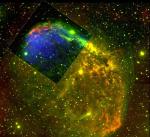 NGC 6888: X Rays in the Wind
16.10.2003
NGC 6888, also known as the Crescent Nebula, is a cosmic bubble of interstellar gas about 25 light-years across. Created by winds from the bright, massive star seen near the center of this composite image, the shocked filaments of gas glowing at optical wavelengths are represented in green and yellowish hues.
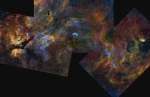 Cygnus Trio
6.11.2008
In this colorful mosaic, filaments of gas and dust span some 9 degrees across central Cygnus, a nebula rich constellation along the northern Milky Way. A trio of nebulae with popular names highlights the beautiful skyscape - the Butterfly, the Crescent, and the Tulip.
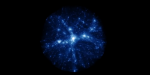 Dark Matter Movie from the Bolshoi Simulation
3.10.2011
What if you could fly through the universe and see dark matter? While the technology for taking such a flight remains under development, the technology for visualizing such a flight has taken a grand leap forward with the completion of the Bolshoi Cosmological Simulation.
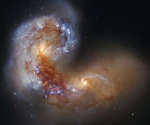 Spiral Galaxy NGC 4038 in Collision
12.08.2012
This galaxy is having a bad millennium. In fact, the past 100 million years haven't been so good, and probably the next billion or so will be quite tumultuous. Visible on the upper...
 Elements in the Aftermath
31.07.2019
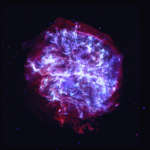
Massive stars spend their brief lives furiously burning nuclear fuel. Through fusion at extreme temperatures and densities surrounding the stellar core, nuclei of light elements ike Hydrogen and Helium are combined to heavier elements like Carbon, Oxygen, etc. in a progression which ends with Iron.
 The Vertical Magnetic Field of NGC 5775
26.01.2021
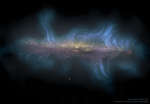
How far do magnetic fields extend up and out of spiral galaxies? For decades astronomers knew only that some spiral galaxies had magnetic fields. However, after NRAO's Very Large Array (VLA) radio telescope...
 APOD: 2024 July 23 Б The Crab Nebula from Visible to X Ray
22.07.2024
What powers the Crab Nebula? A city-sized magnetized neutron star spinning around 30 times a second. Known as the Crab Pulsar, it is the bright spot in the center of the gaseous swirl at the nebula's core.
 Carina Nebula Close Up
14.02.2020
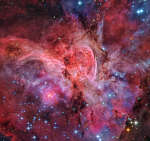
A jewel of the southern sky, the Great Carina Nebula, also known as NGC 3372, spans over 300 light-years, one of our galaxy's largest star forming regions. Like the smaller, more northerly Great...
 Supernova Remnant Cassiopeia A
13.12.2023
Massive stars in our Milky Way Galaxy live spectacular lives. Collapsing from vast cosmic clouds, their nuclear furnaces ignite and create heavy elements in their cores. After only a few million years for the most massive stars, the enriched material is blasted back into interstellar space where star formation can begin anew.
 The Spinning Pulsar of the Crab Nebula
20.08.2022
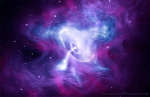
At the core of the Crab Nebula lies a city-sized, magnetized neutron star spinning 30 times a second. Known as the Crab Pulsar, it is the bright spot in the center of the gaseous swirl at the nebula's core.
|
January February March April May June July August September October |
|||||||||||||||||||||||||||||||||||||||||||||||||