
|
You entered: dust lanes
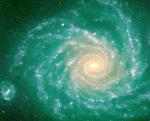 Spiral Galaxy NGC 1232
22.05.2001
Galaxies are fascinating not only for what is visible, but for what is invisible. Grand spiral galaxy NGC 1232, captured in detail by one of the new Very Large Telescopes, is a good example.
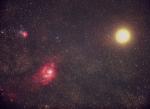 Messiers and Mars
15.06.2001
A telescopic tour of the constellation Sagittarius offers the many bright clusters and nebulae of dimensioned space in a starscape surrounding the galactic center. This gorgeous color deep-sky photograph visits two such lovely sights, cataloged by the 18th century cosmic tourist Charles Messier as M8 and M20.
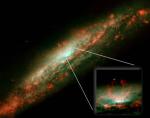 The Bubbling Cauldron of NGC 3079
16.10.2004
Edge-on spiral galaxy NGC 3079 is a mere 50 million light-years away toward the constellation Ursa Major. Shown in this stunning false-color Hubble Space Telescope image, the galaxy's disk - composed of spectacular star clusters in winding spiral arms and dramatic dark lanes of dust - spans some 70,000 light-years.
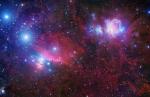 The Orion Deep Field
6.01.2007
Adrift 1,500 light-years away in one of the night sky's most recognizable constellations, the glowing Orion Nebula and the dark Horsehead Nebula are contrasting cosmic vistas. But even fainter filaments of glowing...
 NGC 5584: Expanding the Universe
30.03.2011
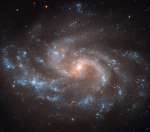
Big, beautiful NGC 5548 is more that 50,000 light-years across and lies 72 million light-years away toward the constellation Virgo. The winding spiral arms of this gorgeous island universe are loaded with luminous young star clusters and dark dust lanes. Still, for earthbound astronomers NGC 5548 is not just another pretty face-on spiral galaxy.
 NGC 1316: After Galaxies Collide
2.02.2017
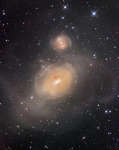
An example of violence on a cosmic scale, enormous elliptical galaxy NGC 1316 lies about 75 million light-years away toward Fornax, the southern constellation of the Furnace. Investigating the startling sight, astronomers suspect the giant galaxy of colliding with smaller neighbor NGC 1317 seen just above, causing far flung loops and shells of stars.
 Hickson 44 in Leo
4.04.2025
Scanning the skies for galaxies, Canadian astronomer Paul Hickson and colleagues identified some 100 compact groups of galaxies, now appropriately called Hickson Compact Groups. The four prominent galaxies seen in this intriguing telescopic skyscape are one such group, Hickson 44.
 Barred Spiral Galaxy M95
14.03.2007
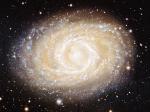
Why do some spiral galaxies have a ring around the center? First and foremost, M95 is one of the closer examples of a big and beautiful barred spiral galaxy. Visible in the above recent...
 A View Toward M101
15.03.2019
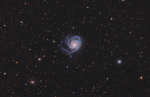
Big, beautiful spiral galaxy M101 is one of the last entries in Charles Messier's famous catalog, but definitely not one of the least. About 170,000 light-years across, this galaxy is enormous, almost twice the size of our own Milky Way galaxy.
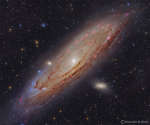 APOD: 2023 March 22 Б M31: The Andromeda Galaxy
22.03.2023
How far can you see? The most distant object easily visible to the unaided eye is M31, the great Andromeda Galaxy, over two million light-years away. Without a telescope, even this immense spiral galaxy appears as an unremarkable, faint, nebulous cloud in the constellation Andromeda.
|
January February March April May June July August |
||||||||||||||||||||||||||||||||||||||||||||||||||||||||