
|
You entered: zodiacal light
 The Sky from Mauna Kea
10.05.2015
What if you could stand at the top of a volcano and peer out across the universe? It the timing is right, you might see an amazing panorama like the one featured here.
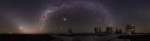 Wonder and Mystery above the Very Large Telescopes
9.05.2011
What's that bright orange dot above the large telescope on the right? Even seasoned sky enthusiasts might ponder the origin of the orange orb seen by scrolling across this panoramic image, taken last December. Perhaps identifying known objects will help.
 APOD: 2025 April 23 Б An Almost Everything Sky
22.04.2025
This surprising sky has almost everything. First, slanting down from the upper left and far in the distance is the central band of our Milky Way Galaxy. More modestly, slanting down from the upper right and high in Earth's atmosphere is a bright meteor.
 Chilean Skyscape
28.11.2008
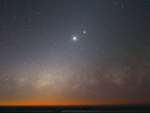
Night skies over Chilean mountain top observatories can be dark and clear, with glorious cosmic vistas. In this recent example, the plane of our Milky Way galaxy stretches parallel to the horizon, the galactic center's star clusters, dark dust clouds, and glowing nebulae hovering in the west.
 Arches of Spring
28.04.2017
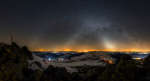
Two luminous arches stretched across the dome of the sky on this northern spring night. After sunset on March 29, the mountain view panorama was captured in 57 exposures from Chopok peak in central Slovakia at an altitude of about 2,000 meters.
 Once Upon a Solstice Eve
22.12.2016
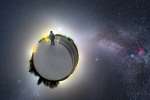
Once upon a solstice eve a little prince gazed across a frozen little planet at the edge of a large galaxy. The little planet was planet Earth of course, seen in this horizon to horizon, nadir to zenith projection, a digitally stitched mosaic from the shores of the Sec reservoir in the Czech Republic.
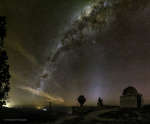 Milky Way over Bosque Alegre Station in Argentina
21.09.2015
What are those streaks of light in the sky? First and foremost, the arching structure is the central band of our Milky Way galaxy. Visible in this galactic band are millions of distant stars mixed with numerous lanes of dark dust.
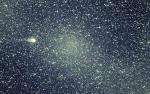 The Gegenschein
25.06.1999
If you look carefully enough, you can even see the glow of the Sun in the opposite direction. At night this glow is known as the gegenschein (German for "counter glow"), and can be seen as a faint glow in an extremely dark sky, as pictured above.
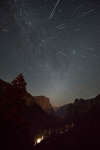 Perseid Night at Yosemite
17.08.2016
The 2016 Perseid meteor shower performed well on the night of August 11/12. The sky on that memorable evening was recorded from a perch overlooking Yosemite Valley, planet Earth, in this scene composed of 25 separate images selected from an all-night set of sequential exposures.
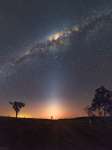 Light at the End of the Road
31.08.2016
The bright light at the end of this country road is actually a remarkably close conjunction of two planets. After sunset on August 27 brilliant Venus and Jupiter almost appear as a single celestial beacon in the night skyscape taken near Lake Wivenhoe, Queensland, Australia.
|
January February March April May June July August September |
|||||||||||||||||||||||||||||||||||||||||||||||||