
|
You entered: asterism
 The Milky Way Near the Northern Cross
15.05.1996
This beautiful image of the sky near the bright star Deneb (just above center) reveals the stars, nebulae, and dark clouds along the plane of our Milky Way Galaxy as seen from the northern hemisphere (near Columbia Missouri, USA). Just below Deneb lies the suggestively shaped North American emission nebula.
 APOD: 2023 May 29 Б Milky Way over a Turquoise Wonderland
29.05.2023
What glows there? The answer depends: sea or sky? In the sea, the unusual blue glow is bioluminescence. Specifically, the glimmer arises from Noctiluca scintillans, single-celled plankton stimulated by the lapping waves. The plankton use their glow to startle and illuminate predators.
 The 37 Cluster
14.05.2024
For the mostly harmless denizens of planet Earth, the brighter stars of open cluster NGC 2169 seem to form a cosmic 37. Did you expect 42? From our perspective, the improbable numerical asterism appears solely by chance. It lies at an estimated distance of 3,300 light-years toward the constellation Orion.
 Starry Night Over the Rhone
21.09.2010
How can the majesty of the night sky best be captured in a painting? This was a continual challenge for Vincent van Gogh, a famous painter in the late 1800s who pioneered stirring depictions of star filled skies into several of his works.
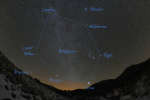 Winter Hexagon Over Stagecoach Colorado
3.01.2011
If you can find Orion, you might be able to find the Winter Hexagon. The Winter Hexagon involves some of the brightest stars visible, together forming a large and easily found pattern in the winter sky of Earth's northern hemisphere.
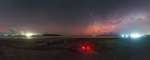 Big Dipper to Southern Cross
31.03.2016
Welcome to an equatorial night. This remarkable 24 frame night skyscape was captured from Maba Beach on the Indonesian island of Halmahera during the evening of March 4. Seen from a mere 0.7 degrees northern latitude, both famous northern and southern asterisms and navigational aids lie within the panoramic view.
 Quadrantids of the North
11.01.2024
Named for a forgotten constellation, the Quadrantid Meteor Shower puts on an annual show for planet Earth's northern hemisphere skygazers. The shower's radiant on the sky lies within the old, astronomically obsolete constellation Quadrans Muralis.
 APOD: 2023 June 20 Б The Nandu in the Milky Way
20.06.2023
Have you seen the bird in the Milky Way? Beyond the man in the Moon, the night sky is filled with stories, and cultures throughout history have projected some of their most enduring legends onto the stars and dust above. Generations of people see these celestial icons, hear their associated stories, and pass them down.
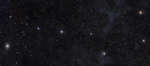 The Big Dipper
24.06.2011
The best known asterism in northern skies, The Big Dipper is easy to recognize, though some might see The Plough. Either way, the star names and the familiar outlines will appear in this thoughtfully composed 24 frame mosaic when you slide your cursor over the image.
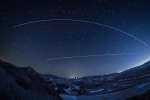 Space Stations in Low Earth Orbit
7.01.2023
On January 3, two space stations already illuminated by sunlight in low Earth orbit crossed this dark predawn sky. Moving west to east (left to right) across the composited timelapse image China's Tiangong Space Station traced the upper trail captured more than an hour before the local sunrise.
|
January February March April May June July August September |
|||||||||||||||||||||||||||||||||||||||||||||||||