
|
You entered: asterism
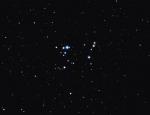 The 37 Cluster
17.11.2005
For the mostly harmless denizens of planet Earth, the brighter stars of open cluster NGC 2169 seem to form a cosmic 37. (Did you expect 42?.) Of course, the improbable numerical asterism appears solely by chance and lies at an estimated distance of 3,600 light-years toward the constellation Orion.
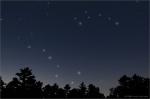 The Big Dipper
7.01.2007
Do you see it? This common question frequently precedes the rediscovery of one of the most commonly recognized configurations of stars on the northern sky: the Big Dipper. This grouping of stars is one of the few things that has likely been seen, and will be seen, by every generation.
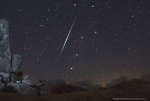 Meteor in the Desert Sky
10.12.2010
Created as planet Earth sweeps through dusty debris from mysterious, asteroid-like, 3200 Phaethon, the annual Geminid Meteor Shower should be the best meteor shower of the year. The Geminids are predicted to peak on the night of December 13/14, but you can start watching for Geminid meteors this weekend.
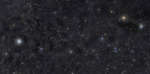 The Little Dipper
14.05.2011
At 2nd magnitude, Polaris is far from the brightest star in the night sky. But it is the brightest star at the left of this well-composed, starry mosaic spanning about 23 degrees across the northern sky asterism dubbed the Little Dipper.
 A Spectacular Sky Over the Grand Tetons
14.08.2007
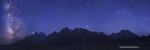
Behold the breathtaking beauty of Earth and sky together. In the foreground is the Teton Mountain Range of Wyoming, USA. The Grand Tetons are a relatively isolated set of high peaks that are part of the Rocky Mountains.
 The Big Dipper Cluster
16.03.2006
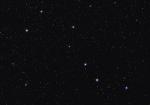
A well-known asterism in northern skies, The Big Dipper is easy to recognize even when viewed upside down. Part of the larger constellation of Ursa Major, the bright dipper stars above are named (left to right along the dipper) Dubhe, Merak, Phecda, Megrez, Alioth, Mizar/Alcor, and Alkaid.
 The Big Dipper
21.04.2013
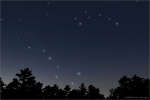
Do you see it? This common question frequently precedes the rediscovery of one of the most commonly recognized configurations of stars on the northern sky: the Big Dipper. This grouping of stars is one of the few things that has likely been seen, and will be seen, by every generation.
 Stars in a Dusty Sky
28.09.2012
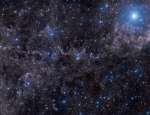
Bright star Markab anchors this dusty skyscape. At the top right corner of the frame, Markab itself marks a corner of an asterism known as the Great Square, found within the boundaries of the constellation Pegasus, the flying horse.
 Light and Glory over Crete
15.11.2020
The month was July, the place was the Greek island of Crete, and the sky was spectacular. Of course there were the usual stars like Polaris, Vega, and Antares -- and that common asterism everyone knows: the Big Dipper. But this sky was just getting started.
 Meteors along the Milky Way
23.08.2023
Under dark and mostly moonless night skies, many denizens of planet Earth were able to watch this year's Perseid meteor shower. Seen from a grassy hillside from Shiraz, Iran these Perseid meteors streak along the northern summer Milky Way before dawn on Sunday, August 13.
|
January February March April May June July August September |
|||||||||||||||||||||||||||||||||||||||||||||||||