
|
You entered: Earth
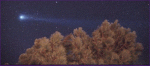 Comet Hyakutake and a Tree
10.04.1996
Comet Hyakutake is still visible as it continues its orbit around the Sun. The comet will brighten again in late April and early May. The above fascinating picture was taken with a three minute exposure. In the middle of the exposure, the photographer cleverly set off a flash, momentarily illuminating the foreground tree.
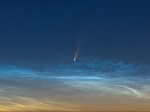 Comet NEOWISE Rising over the Adriatic Sea
13.07.2020
This sight was worth getting out of bed early. Comet C/2020 F3 (NEOWISE) has been rising before dawn during the past week to the delight of northern sky enthusiasts awake that early. Up before...
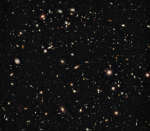 HUDF Infrared: Dawn of the Galaxies
9.12.2009
When did galaxies form? To help find out, the deepest near-infrared image of the sky ever has been taken of the same field as the optical-light Hubble Ultra Deep Field (HUDF) in 2004. The new image was taken this summer by the newly installed Wide Field Camera 3 on the refurbished Hubble Space Telescope.
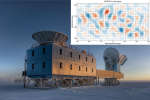 Cosmic Microwave Map Swirls Indicate Inflation
18.03.2014
Did the universe undergo an early epoch of extremely rapid expansion? Such an inflationary epoch has been postulated to explain several puzzling cosmic attributes such as why our universe looks similar in opposite directions.
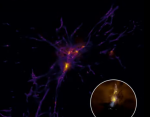 Simulation: Formation of the First Stars
30.06.2021
How did the first stars form? To help find out, the SPHINX computer simulation of star formation in the very early universe was created, some results of which are shown in the featured video. Time since the Big Bang is shown in millions of years on the upper left.
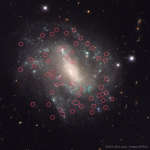 The Supernova and Cepheids of Spiral Galaxy UGC 9391
6.06.2016
What can this galaxy tell us about the expansion rate of the universe? Perhaps a lot because UGC 9391, featured, not only contains Cepheid variable stars (red circles) but also a recent Type Ia supernova (blue X).
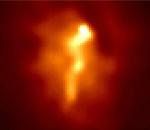 Abell 1795: A Galaxy Cluster s Cooling Flow
8.12.2000
Throughout the Universe, galaxies tend to swarm in groups ranging from just a handful of members to casts of thousands. Astronomers have realized since the early 1970s that the larger swarms, immense clusters of galaxies millions of light-years across, are immersed within tenuous clouds of hot gas which glow strongly in x-rays.
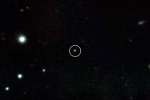 GRB 090423: The Farthest Explosion Yet Measured
29.04.2009
An explosion so powerful it was seen clear across the visible universe was recorded in gamma-radiation last week by NASA's orbiting Swift Observatory. Farther than any known galaxy, quasar, or optical supernova, the gamma-ray burst recorded last week was clocked at redshift 8.2, making it the farthest explosion of any type yet detected.
 New Data: Ultima Thule Surprisingly Flat
11.02.2019
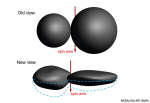
Ultima Thule is not the object humanity thought that it was last month. When the robotic New Horizons spacecraft zoomed past the distant asteroid Ultima Thule (officially 2014 MU69) in early January, early images showed two circular lobes that when most simply extrapolated to 3D were thought to be, roughly, spheres.
 Moon, Venus, Jupiter, Phoenix
25.08.1998
Before a relaxing sunrise, the sky begins to glow with unusual delights. Such was the view from Papago Park in Phoenix, Arizona this April. The glittering objects visible in this photograph are, from lower left to upper right: Phoenix, our Moon, Venus, and Jupiter. Such proximity is somewhat unusual.
|
January February March April May June July August September October |
|||||||||||||||||||||||||||||||||||||||||||||||||