
|
You entered: Earth
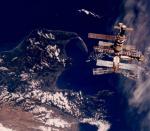 Mir Dreams
27.03.2004
This dream-like image of Mir was recorded by astronauts as the Space Shuttle Atlantis approached the Russian space station prior to docking during the STS-76 mission. Sporting spindly appendages and solar panels...
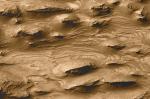 Layered Mars: An Ancient Water World
5.12.2000
Pictured above, layers upon layers stretch across the floor of West Candor Chasma within the immense martian Valles Marineris. Covering an area 1.5 by 2.9 kilometers, the full image from the Mars Global Surveyor spacecraft shows over 100 individual beds.
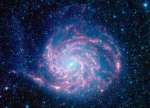 Spitzer s M101
30.12.2009
Big, beautiful spiral galaxy M101 is one of the last entries in Charles Messier's famous catalog, but definitely not one of the least. About 170,000 light-years across, this galaxy is enormous, almost twice the size of our own Milky Way Galaxy.
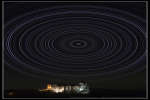 Lewins Challenge: 360 Degree Star Trails
17.07.2011
You could be the first person ever to take a real single-exposure image like this. The above image from Vienna, Austria is not real in the sense that the 360 degree star trails in the sky appear only because of a digital trick.
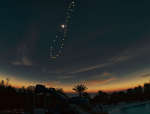 Tutulemma: Solar Eclipse Analemma
22.08.2016
If you went outside at exactly the same time every day and took a picture that included the Sun, how would the Sun's position change? With great planning and effort, such a series of images can be taken. The figure-8 path the Sun follows over the course of a year is called an analemma.
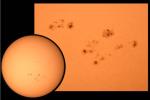 Sunspots and Solar Active Regions
1.08.2002
July was a good month for sunspots ... really big sunspots. In fact, the full disk and inset pictures above show three large groups of spots, photographed only a few days ago on July 28. Together the sunspots span a region about thirty times the diameter of planet Earth.
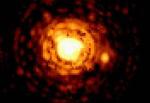 Small Star
5.06.1997
A dim double star system cataloged as Gliese 623 lies 25 light-years from Earth, in the constellation of Hercules. The individual stars of this binary system were distinguished for the first time when the Hubble Space Telescope's Faint Object Camera recorded this image in June 1994.
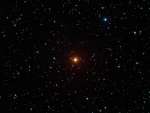 La Superba
18.12.2008
Y Canum Venaticorum (Y CVn) is a very rare star in planet Earth's night sky. It's also very red, exhibiting such a remarkable spectrum of light, 19th century astronomer Angelo Secchi dubbed it La Superba.
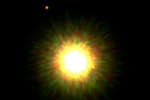 Companion of a Young, Sun-like Star Confirmed
4.07.2010
The first direct image of an extrasolar planet orbiting a star similar to our Sun has been confirmed. Located just 500 light-years away toward the constellation Scorpius, the parent star, cataloged as 1RXS J160929.1-210524, is only slightly less massive and a little cooler than the Sun.
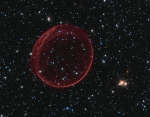 The Rippled Red Ribbons of SNR 0509
25.01.2011
What is causing the picturesque ripples of supernova remnant SNR 0509-67
|
January February March April May June July August September October |
|||||||||||||||||||||||||||||||||||||||||||||||||