
|
You entered: Earth
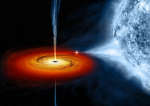 Heavy Black Hole Jets in 4U1630 47
20.11.2013
What are black hole jets made of? Many black holes in stellar systems are surely surrounded by disks of gas and plasma gravitationally pulled from a close binary star companion. Some of this material...
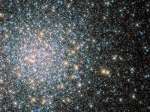 Hubble s Messier 5
25.04.2014
"Beautiful Nebula discovered between the Balance [Libra] & the Serpent [Serpens] ..." begins the description of the 5th entry in 18th century astronomer Charles Messier's famous catalog of nebulae and star clusters. Though it appeared...
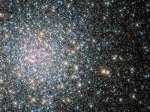 Hubble s Messier 5
20.06.2015
"Beautiful Nebula discovered between the Balance [Libra] & the Serpent [Serpens] ..." begins the description of the 5th entry in 18th century astronomer Charles Messier's famous catalog of nebulae and star clusters. Though it appeared...
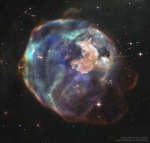 N63A: Supernova Remnant in Visible and X-ray
11.12.2019
What has this supernova left behind? As little as 2,000 years ago, light from a massive stellar explosion in the Large Magellanic Cloud (LMC) first reached planet Earth. The LMC is a close...
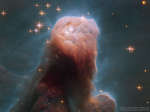 The Cone Nebula from Hubble
15.03.2017
Stars are forming in the gigantic dust pillar called the Cone Nebula. Cones, pillars, and majestic flowing shapes abound in stellar nurseries where natal clouds of gas and dust are buffeted by energetic winds from newborn stars. The Cone Nebula, a well-known example, lies within the bright galactic star-forming region NGC 2264.
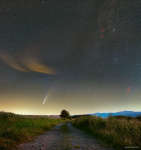 Comet NEOWISE and Nebulae
20.07.2020
Would you brave wild animals to photograph this sky? One astrophotographer did -- and we all get to reap the rewards. First, thousands of stars were visible with many of the brightest impressively blue. Next, several red-glowing nebulae were discernible, including the California Nebula on the far right, and, above it, the Heart and Soul nebulae.
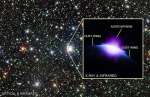 APOD: 2026 March 6 Б The Astrosphere of HD 61005
6.03.2026
Do young stars blow bubbles? The larger view shows a stellar field observed with the Cerro Tololo Inter-American Observatory in Chile, and the inset highlights HD 61005, a star like our Sun, only 120 light-years away.
 A 2017 U1: An Interstellar Visitor
3.11.2017
Traveling at high velocity along an extreme hyperbolic orbit and making a hairpin turn as it swung past the Sun, the now designated A/2017 U1 is the first known small body from interstellar space.
 APOD: 2023 April 2 Б M57: The Ring Nebula from Hubble
2.04.2023
It was noticed hundreds of years ago by stargazers who could not understand its unusual shape. It looked like a ring on the sky. Except for the rings of Saturn, the Ring Nebula (M57) may be the most famous celestial circle.
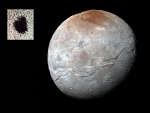 APOD: 2026 June 6 Б Charon: Moon of Pluto
6.06.2026
A darkened and mysterious north polar region known to some as Mordor Macula caps this premier view of Charon, Pluto's largest moon. The high-resolution image was captured by the interplanetary space probe New Horizons near its closest approach to distant Pluto on July 14, 2015.
|
January February March April May June July August September October |
|||||||||||||||||||||||||||||||||||||||||||||||||