
|
You entered: sky
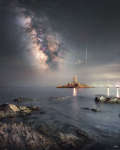 Meteor and Milky Way over the Mediterranean
23.08.2022
Careful planning made this a nightscape to remember. First, the night itself was chosen to occur during the beginning of this year's Perseid Meteor Shower. Next, the time of night was chosen to be before the bright Moon would rise and dominate the night sky's brightness.
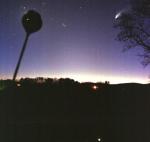 A Hale-Bopp Triple Crown
23.07.1997
It was truly a busy sky. In one of the more spectacular photos yet submitted to Astronomy Picture of the Day, Don Cooke of Lyme, New Hampshire caught the Sun, Moon, Earth, night sky, Pleiades star cluster, and Comet Hale-Bopp all in one frame.
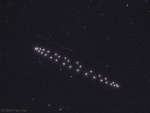 APOD: 2026 May 6 Б The Retrograde Dance of Saturn and Neptune
6.05.2026
What does it mean for Saturn and Neptune to be in retrograde? Featured is a composite of images taken over 34 nights from May 2025 to February 2026 tracing Saturn (brighter, foreground) and Neptune (dimmer, background). Over that time, the two planets exhibited retrograde motion, meaning they appeared to move backward in the sky.
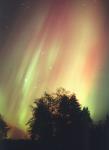 October Skylights
8.11.2000
With brilliant Venus above the western horizon at sunset and Jupiter and Saturn high in the east by early evening, November's night sky is filled with bright planets. October's sky featured bright planets as well and, triggered by the active Sun, some lovely auroral displays.
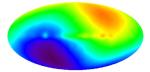 COBE Dipole: Speeding Through the Universe
27.06.1999
Our Earth is not at rest. The Earth moves around the Sun. The Sun orbits the center of the Milky Way Galaxy. The Milky Way Galaxy orbits in the Local Group. The Local Group falls toward the Virgo Cluster of Galaxies.
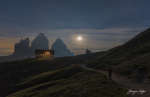 The Moon and Jupiter over the Alps
2.09.2019
What are those bright lights in the sky ahead? When hiking a high mountain pass in northern Italy three weeks ago, a conjunction between our Moon and the distant planet Jupiter was visible as both rose together in the southwest after sunset.
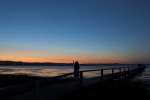 Planets Ahoy
30.09.2008
Can you spot the Solar System's four rocky planets? In the above image taken on September 20, all of them were visible in a single glance, but some of them may be different than you think. Pictured above, the brightest and highest object in the sky is the planet Venus.
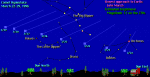 Where to See Comet Hyakutake
22.03.1996
People the world over are preparing to witness the closest approach of the brightest comet of the past twenty years. Comet Hyakutake, discovered just two months ago, will pass nearest the Earth Monday morning. All during the coming week, Comet Hyakutake will be visible in the northern sky as an unusual extended fuzzy patch.
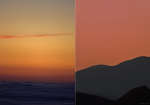 Two Views, Two Crescents
11.11.2010
Venus rose in a glowing dawn sky on November 5th, just before the Sun. For early morning risers, its brilliant crescent phase was best appreciated with binoculars or a small telescope. On that...
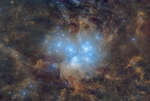 APOD: 2026 February 23 Б Pleiades: The Seven Sisters Star Cluster
23.02.2026
Have you ever seen the Pleiades star cluster? Even if you have, you probably have never seen it as large and clear as this. Perhaps the most famous star cluster on the sky, the bright stars of the Pleiades can be seen with the unaided eye even from the depths of a light-polluted city.
|
January February March April May June July August September October |
|||||||||||||||||||||||||||||||||||||||||||||||||