
|
You entered: sky
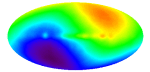 COBE Dipole: Speeding Through the Universe
8.03.1997
Our Earth is not at rest. The Earth moves around the Sun. The Sun orbits the center of the Milky Way Galaxy. The Milky Way Galaxy orbits in the Local Group. The Local Group falls toward the Virgo Cluster of Galaxies.
 The Belt of Venus over the Valley of the Moon
21.10.2003
Although you've surely seen it, you might not have noticed it. During a cloudless twilight, just before sunrise or after sunset, part of the atmosphere above the horizon appears slightly off-color, slightly pink.
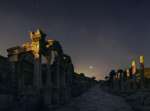 Jupiter over Ephesus
18.07.2008
A brilliant Jupiter shares the sky with the Full Moon tonight. Since Jupiter is near opposition, literally opposite the Sun in planet Earth's sky, Jupiter will rise near sunset just like the Full Moon.
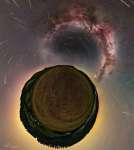 Perseids Over a Little Planet
12.08.2026
It looks like a view from the Little Prince's planet. The featured image is a throwback to the 2024 Perseid meteor shower, surrounded in this projection by the Bieszczady Mountains in Poland. Visible...
 The Belt of Venus over the Valley of the Moon
4.04.2010
Although you've surely seen it, you might not have noticed it. During a cloudless twilight, just before sunrise or after sunset, part of the atmosphere above the horizon appears slightly off-color, slightly pink.
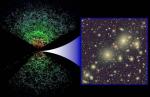 The SDSS 3D Universe Map
28.10.2003
The latest map of the cosmos again indicates that dark matter and dark energy dominate our universe. The Sloan Digital Sky Survey (SDSS) is on its way to measuring the distances to over one million galaxies.
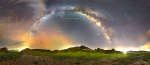 Perseids Around the Milky Way
17.08.2020
Why would meteor trails appear curved? The arcing effect arises only because the image artificially compresses (nearly) the whole sky into a rectangle. The meteors are from the Perseid Meteor Shower that peaked last week.
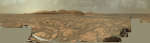 Curiosity: Sol 3048
25.03.2021
Before Perseverance there was Curiosity. In fact, the Curiosity rover accomplished the first sky crane maneuver touchdown on Mars on April 5, 2012. March 2, 2021 marked Curiosity's 3,048th martian day operating on the surface of the Red Planet.
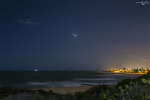 APOD: 2023 March 5 Б Jupiter and Venus over Italy
5.03.2023
What are those two bright spots? Planets. A few days ago, the two brightest planets in the night sky passed within a single degree of each other in what is termed a conjunction. Visible just after sunset in much of the world, the two bright spots were Jupiter (left) and Venus (right).
 APOD: 2024 June 26 Б Timelapse: Aurora, SAR, and the Milky Way
26.06.2024
What's happening in the sky this unusual night? Most striking in the featured 4.5-hour 360-degree panoramic video, perhaps, is the pink and purple aurora. That's because this night, encompassing May 11, was famous for its auroral skies around the world.
|
January February March April May June July August September October |
|||||||||||||||||||||||||||||||||||||||||||||||||