
|
You entered: disk
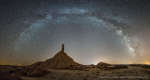 Milky Way Over Spains Bardenas Reales
2.09.2013
What's that below the Milky Way? First, across the top of the above image, lies the faint band that is our planet's sideways view of the central disk of our home Milky Way Galaxy.
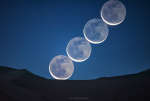 Da Vinci Rise
25.09.2019
An old Moon rose this morning, its waning sunlit crescent shining just above the eastern horizon before sunrise. But earthshine, light reflected from a bright planet Earth, lit the shadowed portion of the lunar disk and revealed most of a familiar lunar near side to early morning risers.
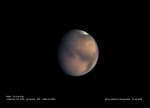 The Red Planet Mars
29.07.2020
Mars looks pretty sharp in this backyard telescope image captured on July 23 from Hoegaarden, Belgium, planet Earth. The Red Planet's bright south polar cap is bathed in sunlight at the top of the inverted view, while the dark feature known as Syrtis Major extends toward the right (eastern) edge.
 APOD: 2024 October 9 Б M106: A Spiral Galaxy with a Strange Center
8.10.2024
What's happening at the center of spiral galaxy M106? A swirling disk of stars and gas, M106's appearance is dominated by blue spiral arms and red dust lanes near the nucleus, as shown in the featured image taken from the Kuwaiti desert.
 The Tidal Tail of NGC 3628
27.07.2007
A mere 30 million light-years away, large spiral galaxy NGC 3628 (center) shares its neighborhood in the local Universe with two other large spirals, in a magnificent grouping otherwise known as the Leo Triplett.
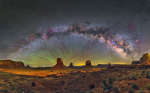 The Milky Way over Monument Valley
25.07.2017
You don't have to be at Monument Valley to see the Milky Way arc across the sky like this -- but it helps. Only at Monument Valley USA would you see a picturesque foreground that includes these iconic rock peaks called buttes.
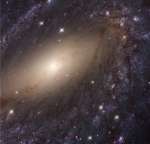 NGC 6744 Close Up
30.05.2018
Beautiful spiral galaxy NGC 6744 is nearly 175,000 light-years across, larger than our own Milky Way. It lies some 30 million light-years distant in the southern constellation Pavo, its galactic disk tilted towards our line of sight.
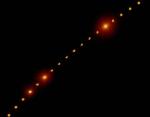 Second Millennium, Last Eclipse
4.01.2001
Christmas Day 2000 featured the final eclipse of the Second Millennium -- a partial solar eclipse visible from much of North America. Astrophotographer Phil Rau recorded the entire event on a single image as the Sun and Moon arced through winter skies above Cary, North Carolina, USA.
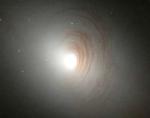 NGC 2787: A Barred Lenticular Galaxy
8.04.2002
Lenticular galaxies aren't supposed to be photogenic. Like spiral galaxies, they contain a disk, but like elliptical galaxies, they are usually short on dust, gas, and pretty spiral arms. Lenticulars are relatively little studied, possibly because of their seemingly benign nature. Famous galaxies historically classified as lenticular include M84, M85, and M86.
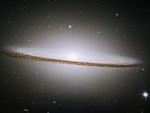 The Sombrero Galaxy from HST
8.10.2003
Why does the Sombrero Galaxy look like a hat? Reasons include the Sombrero's unusually large and extended central bulge of stars, and dark prominent dust lanes that appear in a disk that we see nearly edge-on. Billions of old stars cause the diffuse glow of the extended central bulge.
|
January February March April May June July August |
||||||||||||||||||||||||||||||||||||||||||||||||||||||||