
|
You entered: disk
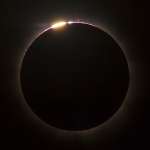 Solar Eclipse over Queensland
15.11.2012
This month's New Moon brought a total solar eclipse to parts of planet Earth on November 13 (UT). Most of the total eclipse track fell across the southern Pacific, but the Moon's dark umbral shadow began its journey in northern Australia on Wednesday morning, local time.
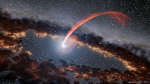 A Black Hole Disrupts a Passing Star
23.03.2020
What happens to a star that goes near a black hole? If the star directly impacts a massive black hole, then the star falls in completely -- and everything vanishes. More likely, though, the star...
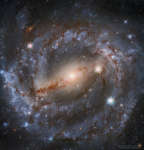 NGC 5643: Nearby Spiral Galaxy from Hubble
4.10.2020
What's happening at the center of spiral galaxy NGC 5643? A swirling disk of stars and gas, NGC 5643's appearance is dominated by blue spiral arms and brown dust, as shown in the featured image taken by the Hubble Space Telescope.
 Moonrays of August
3.08.2023
A Full Moon rose as the Sun set on August 1. Near perigee, the closest point in its almost moonthly orbit, the brighter than average lunar disk illuminated night skies around planet Earth as the second supermoon of 2023.
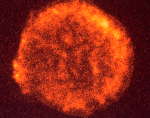 Tycho's Supernova Remnant in X-ray
23.06.1996
How often do stars explode? By looking at external galaxies, astronomers can guess that these events, known as a supernovae, should occur about once every 30 years in a typical spiral galaxy like our MilkyWay.
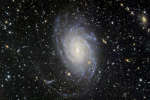 Spiral Galaxy NGC 6744
25.05.2017
Big, beautiful spiral galaxy NGC 6744 is nearly 175,000 light-years across, larger than our own Milky Way. It lies some 30 million light-years distant in the southern constellation Pavo appearing as a faint, extended object in small telescopes. We see the disk of the nearby island universe tilted towards our line of sight.
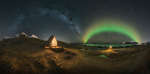 Arches Across an Arctic Sky
12.01.2021
What are these two giant arches across the sky? Perhaps the more familiar one, on the left, is the central band of our Milky Way Galaxy. This grand disk of stars and nebulas here appears to encircle much of the southern sky.
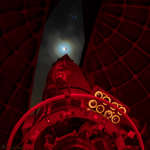 Great Refractor and Lunar Eclipse
25.11.2021
Rain clouds passed and the dome of the Lick Observatory's 36 inch Great Refractor opened on November 19. The historic telescope was pointed toward a partially eclipsed Moon. Illuminated by dim red lighting...
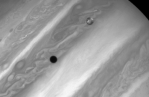 Io's Shadow
7.10.1996
Caught in the act earlier this summer by the Hubble Space Telescope, the volcanic moon Io (above and right of center) and its shadow (black dot) are seen here against Jupiter's clouds.
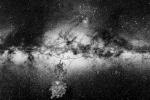 Sagittarius Dwarf to Collide with Milky Way
15.02.1998
Our Galaxy is being invaded. Recent observations indicate that in the next 100 million years, the Sagittarius Dwarf galaxy will move though the disk of our own Milky Way Galaxy yet again . The Sagittarius...
|
January February March April May June July August |
||||||||||||||||||||||||||||||||||||||||||||||||||||||||