
|
You entered: NASA
 APOD: 2023 October 10 Б Hidden Orion from Webb
10.10.2023
The Great Nebula in Orion has hidden stars. To the unaided eye in visible light, it appears as a small fuzzy patch in the constellation of Orion. But this image was taken by the Webb Space Telescope in a representative-color composite of red and very near infrared light.
 APOD: 2023 October 24 Б Arp 87: Merging Galaxies from Hubble
24.10.2023
This dance is to the death. As these two large galaxies duel, a cosmic bridge of stars, gas, and dust currently stretches over 75,000 light-years and joins them. The bridge itself is strong evidence that these two immense star systems have passed close to each other and experienced violent tides induced by mutual gravity.
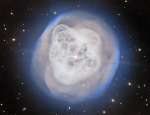 APOD: 2026 May 28 Б NGC 1514: The Crystal Ball Nebula
28.05.2026
What do you see in this crystal ball? The featured image shows NGC 1514, known as the Crystal Ball Nebula, observed by the Gemini North telescope on Maunakea, in Hawai'i. NGC 1514 is 1,500 light-years away and was discovered by William Herschel in 1790.
 VAR
VAR
1.07.2011
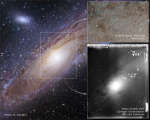
In the 1920s, examining photographic plates from the Mt. Wilson Observatory's 100 inch telescope, Edwin Hubble determined the distance to the Andromeda Nebula, decisively demonstrating the existence of other galaxies far beyond the Milky Way.
 Sutter s Mill Meteorite
28.04.2012
Last Sunday's bright fireball meteor falling through skies over California and Nevada produced sonic booms over a broad area around 7:21 am. Estimates indicate the meteor was about the size of a minivan.
 Zeta Oph: Runaway Star
29.12.2012
Like a ship plowing through cosmic seas, runaway star Zeta Ophiuchi produces the arcing interstellar bow wave or bow shock seen in this stunning infrared portrait. In the false-color view, bluish Zeta...
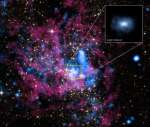 The Quiet Sagittarius A
6.09.2013
Hot gas is hard to swallow. At least that seems to be true for the supermassive black hole at the center of our Milky Way Galaxy. Known as source Sagittarius A*, the Milky Way's black hole is centered in this infrared (red and yellow hues) and X-ray (blue) composite.
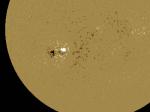 A Backward Sunspot and the New Solar Cycle
30.08.2006
Why is sunspot 905 backwards? Perhaps it is a key marker for the beginning of a new magnetic cycle on our Sun. Every 11 years, our Sun goes through a magnetic cycle, at the end of which its overall magnetic orientation is reversed.
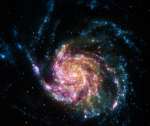 21st Century M101
13.07.2012
One of the last entries in Charles Messier's famous catalog, big, beautiful spiral galaxy M101 is definitely not one of the least. About 170,000 light-years across, this galaxy is enormous, almost twice the size of our own Milky Way Galaxy.
 NGC 253: Close Up
19.05.2011
This dusty island universe is one of the brightest spiral galaxies in planet Earth's sky. Seen nearly edge-on, NGC 253 is only 13 million light-years away, the largest member of the Sculptor Group of galaxies, neighbor to our own local galaxy group.
|
January February March April May June July August September |
|||||||||||||||||||||||||||||||||||||||||||||||||