
|
You entered: phases
 NGC 6888: The Crescent Nebula
28.11.2025
NGC 6888, also known as the Crescent Nebula, is a about 25 light-years across, a cosmic bubble blown by winds from its central, massive star. This deep telescopic image includes narrowband image data, to isolate light from hydrogen and oxygen atoms.
 Denizen of the Tarantula Nebula
3.05.2003
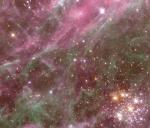
The star cluster at lower right, cataloged as Hodge 301, is a denizen of the Tarantula Nebula. An evocative nebula in the southern sky, the sprawling cosmic Tarantula is an energetic star forming region some 168,000 light-years distant in our neighboring galaxy the Large Magellanic Cloud.
 Cygnus: Bubble and Crescent
4.12.2015
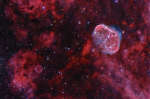
These clouds of gas and dust drift through rich star fields along the plane of our Milky Way Galaxy toward the high flying constellation Cygnus. Caught within the telescopic field of view are the Soap Bubble (lower left) and the Crescent Nebula (upper right).
 Halo from Atacama
18.05.2016
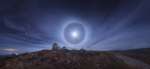
Influenced by the strong Pacific El Nino, cloudy skies have more often come to Chile's high Atacama Desert this season, despite its reputation as an astronomer's paradise. Located...
 A Step Toward Gravitational Wave Detection
30.10.2000
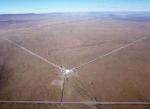
Accelerate a charge and you'll get electromagnetic radiation: light. But accelerate any mass and you'll get gravitational radiation. Light is seen all the time, but, so far, a confirmed direct detection of gravitational radiation has yet to be made.
 Full Venus and Crescent Moon Rise
14.04.2016
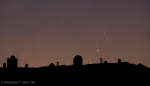
Inner planet Venus and a thin crescent Moon are never found far from the Sun in planet Earth's skies. Taken near dawn on April 6, this timelapse composite shows them both rising just before the Sun. The mountaintop Teide Observatory domes on the fortunate island of Tenerife appear in silhouette against the twilight.
 A Blue Moon in Exaggerated Colors
31.08.2021
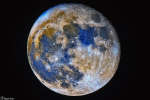
The Moon is normally seen in subtle shades of grey or gold. But small, measurable color differences have been greatly exaggerated to make this telescopic, multicolored, moonscape captured during the Moon's full phase. The different colors are recognized to correspond to real differences in the chemical makeup of the lunar surface.
 Ring of Fire over Monument Valley
9.05.2013
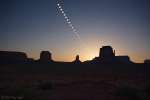
As the New Moon continues this season's celestial shadow play, an annular solar eclipse track begins in western Australia at 22:30 UT on May 9 -- near sunrise on May 10 local time.
 Phobos: Doomed Moon of Mars
22.11.2015
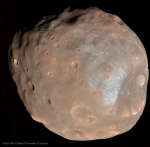
This moon is doomed. Mars, the red planet named for the Roman god of war, has two tiny moons, Phobos and Deimos, whose names are derived from the Greek for Fear and Panic. These...
 Solar Eclipse Shoes in the Classroom
8.03.2016
The total solar eclipse of March 8/9 will be the only total eclipse in 2016. The New Moon's dark shadow traces a limited, narrow path across planet Earth for viewing the total phase, making landfall in Indonesia and mostly tracking across the Pacific Ocean.
|
January February March April May June July August September |
|||||||||||||||||||||||||||||||||||||||||||||||||