
|
You entered: phases
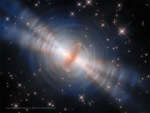 APOD: 2026 February 25 Б The Egg Nebula from the Hubble Telescope
25.02.2026
Ever wonder what it would look like to crack open the Sun? The Egg Nebula, a dying Sun-like star, can unscramble this question. Pictured is a combination of several visible and infrared images of the nebula (also known as RAFGL 2688 or CRL 2688) taken with the Hubble Space Telescope.
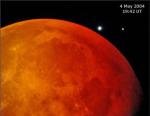 Zubenelgenubi and Friends
14.05.2004
Moderately bright Zubenelgenubi is the star just off the upper right hand limb of an eclipsed Moon in this telescopic view from Port Elizabeth, South Africa. Actually the second brightest star in the constellation...
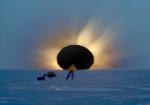 Solar Eclipse in View
7.04.2005
Friday's solar eclipse will be a rare hybrid - briefly appearing as either an annular eclipse or a total eclipse when viewed from along the narrow track of the Moon's shadow. Unfortunately that...
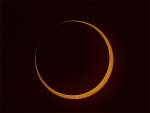 Cape York Annular Eclipse
11.05.2013
This week the shadow of the New Moon fell on planet Earth, crossing Queensland's Cape York in northern Australia ... for the second time in six months. On the morning...
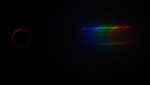 The Flash Spectrum of the Sun
12.03.2016
In a flash, the visible spectrum of the Sun changed from absorption to emission on March 9 during the total solar eclipse. That fleeting moment, at the beginning the total eclipse phase, is captured by telephoto lens and diffraction grating in this image from clearing skies over Ternate, Indonesia.
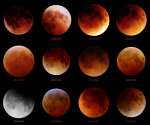 Twelve Lunar Eclipses
29.02.2008
Welcome to the extra day in the Gregorian Calendar's leap year 2008! To celebrate, consider this grid of lunar eclipse pictures - starting in leap year 1996 and ending with February's eclipse - with the date in numerical year/month/day format beneath each image.
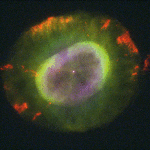 The Blue Snowball Planetary Nebula
21.11.1996
Will the Sun one day look like - a blue snowball? Maybe! The Blue Snowball is a planetary nebula - and in 5 billion years the Sun will throw off its outer layers and go through a planetary nebula phase.
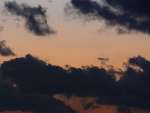 At first he couldn t see the Moon
11.04.2008
At first, he couldn't see it, but searching with binoculars along a cloudy western horizon near sunset, photographer Laurent Laveder finally spotted a delicate lunar crescent. Captured in this dramatic picture on April 6th from Bretagne, France, the Moon was only 15 hours and 38 minutes old.
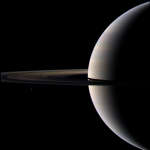 Saturn After Equinox
10.11.2009
The other side of Saturn's ring plane is now directly illuminated by the Sun. For the previous 15 years, the southern side of Saturn and its rings were directly illuminated, but since Saturn's equinox in August, the orientation has reversed.
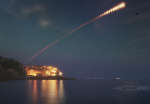 Eclipse over the Gulf of Poets
2.08.2018
The total phase of the July 27 lunar eclipse lasted for an impressive 103 minutes. That makes it the longest total lunar eclipse of the 21st century. The Moon passed through the center of Earth's shadow while the Moon was near apogee, the most distant point in its elliptical orbit.
|
January February March April May June July August September |
|||||||||||||||||||||||||||||||||||||||||||||||||