
|
You entered: background
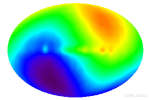 CMB Dipole: Speeding Through the Universe
2.04.2022
Our Earth is not at rest. The Earth moves around the Sun. The Sun orbits the center of the Milky Way Galaxy. The Milky Way Galaxy orbits in the Local Group of Galaxies. The Local Group falls toward the Virgo Cluster of Galaxies.
 APOD: 2024 February 21 Б Seagull Nebula over Pinnacles Peak
20.02.2024
The bird is bigger than the peak. Nicknamed for its avian shape, the Seagull Nebula is an emission nebula on the night sky that is vast, spanning an angle over five times the diameter of the full moon and over 200 light years.
 APOD: 2025 July 10 Б Lynds Dark Nebula 1251
9.07.2025
Stars are forming in Lynds Dark Nebula (LDN) 1251. About 1,000 light-years away and drifting above the plane of our Milky Way galaxy, LDN 1251 is also less appetizingly known as "The Rotten Fish Nebula." The dusty molecular cloud is part of a complex of dark nebulae mapped toward the Cepheus flare region.
 APOD: 2026 January 4 Б The Einstein Cross Gravitational Lens
3.01.2026
Most galaxies have a single nucleus -- does this galaxy have four? The strange answer leads astronomers to conclude that the nucleus of the surrounding galaxy is not even visible in this image. The central cloverleaf is rather light emitted from a background quasar.
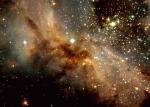 M17: Omega Nebula Star Factory
19.09.2000
In the depths of the dark clouds of dust and molecular gas known as M17, stars continue to form. Visible in the above recently released representative-color photograph of M17 by the New Technology Telescope are clouds so dark that they appear almost empty of near infrared light.
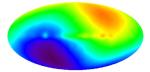 COBE Dipole: Speeding Through the Universe
27.06.1999
Our Earth is not at rest. The Earth moves around the Sun. The Sun orbits the center of the Milky Way Galaxy. The Milky Way Galaxy orbits in the Local Group. The Local Group falls toward the Virgo Cluster of Galaxies.
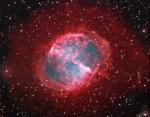 Dumbbell Nebula Halo
25.07.2003
In 1764, French astronomer Charles Messier sighted this gorgeous cosmic cloud which he described as an oval nebula without stars. Cataloged as M27, it is now popularly known as the Dumbbell Nebula...
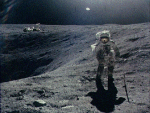 Apollo 16: Exploring Plum Crater
7.06.1996
Apollo 16 spent three days on Earth's Moon in April 1972. The fifth lunar landing mission out of six, Apollo 16 was famous for deploying and using an ultraviolet telescope as the first lunar observatory, and for collecting rocks and data on the mysterious lunar highlands. In the above picture, astronaut John W.
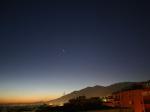 Jupiter and Venus at Sunrise
7.11.2004
What are those bright objects in the morning sky? Early morning dog walkers, among many others across our world's Northern Hemisphere, have likely noticed tremendously bright Venus hanging in the eastern sky just before sunrise. Looking a bit like an approaching airplane, Venus holds its place in the sky and never seems to land.
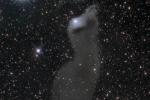 vdB 152: Reflection Nebula in Cepheus
14.06.2007
Described as a "dusty curtain" or "ghostly apparition", mysterious reflection nebula vdB 152 really is very faint. It lies about 1400 light-years away, along the northern Milky Way in the royal constellation Cepheus. Near...
|
January February March April May June July August |
||||||||||||||||||||||||||||||||||||||||||||||||||||||||