
|
You entered: background
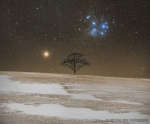 Mars and the Pleiades Beyond Vinegar Hill
6.04.2021
Is this just a lonely tree on an empty hill? To start, perhaps, but look beyond. There, a busy universe may wait to be discovered. First, physically, to the left of the tree, is the planet Mars.
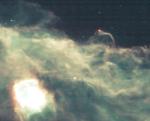 Infrared Horsehead
24.02.2001
This famous cosmic dust cloud was imaged in infrared light by the European Space Agency's Infrared Space Observatory (ISO) satellite. The false-color picture shows the bright infrared emission from dust and molecular gas in part of the Orion star forming region surrounding the Horsehead Nebula.
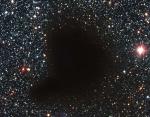 Molecular Cloud Barnard 68
23.09.2001
Where did all the stars go? What used to be considered a hole in the sky is now known to astronomers as a dark molecular cloud. Here, a high concentration of dust and molecular gas absorb practically all the visible light emitted from background stars.
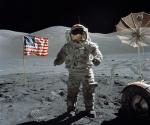 Apollo 17: Last on the Moon
12.12.2002
In December of 1972, Apollo 17 astronauts Eugene Cernan and Harrison Schmitt spent about 75 hours on the Moon, in the Taurus-Littrow valley, while colleague Ronald Evans orbited overhead. Near the beginning of their...
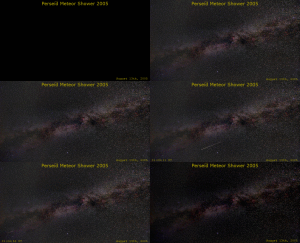 Perseid Meteors and the Milky Way
15.08.2005
Where will the next Perseid meteor appear? Sky enthusiasts who trekked outside for the Perseid meteor shower that peaked over the past few days typically had this question on their mind. The above movie, where the time-line has been digitally altered, captures part of that very mystery.
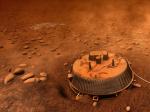 Huygens on Titan Illustrated
31.01.2006
If you could stand on Titan, what might you see? About one year ago the robotic Huygens probe landed on the enigmatic moon of Saturn and sent back the first ever images from beneath Titan's thick cloud layers.
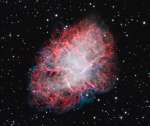 M1: The Incredible Expanding Crab
5.09.2013
The Crab Nebula is cataloged as M1, the first on Charles Messier's famous list of things which are not comets. In fact, the Crab is now known to be a supernova remnant, an expanding cloud of debris from the explosion of a massive star.
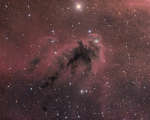 LDN 1622: Dark Nebula in Orion
2.02.2019
The silhouette of an intriguing dark nebula inhabits this cosmic scene. Lynds' Dark Nebula (LDN) 1622 appears against a faint background of glowing hydrogen gas only easily seen in long telescopic exposures of the region.
 Curiosity: Sol 3048
25.03.2021
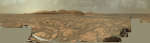
Before Perseverance there was Curiosity. In fact, the Curiosity rover accomplished the first sky crane maneuver touchdown on Mars on April 5, 2012. March 2, 2021 marked Curiosity's 3,048th martian day operating on the surface of the Red Planet.
 Comet Leonard and the Whale Galaxy
3.12.2021
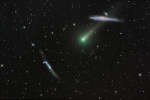
Sweeping through northern predawn skies, on November 24 Comet Leonard (C/2021 A1) was caught between two galaxies in this composite telescopic image. Sporting a greenish coma the comet's dusty tail seems to harpoon the heart of NGC 4631 (top) also known as the Whale Galaxy.
|
January February March April May June July August |
||||||||||||||||||||||||||||||||||||||||||||||||||||||||