
|
You entered: image
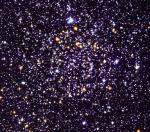 NGC 7789: Galactic Star Cluster
9.07.1999
At 1.6 billion years old, this cluster of stars is beginning to show its age. NGC 7789 is an open or galactic star cluster about 8,000 light-years distant toward the constellation Cassiopeia and lies near the plane of our Milky Way galaxy.
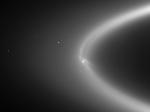 Enceladus Creates Saturns E Ring
27.03.2007
The active moon Enceladus appears to be making Saturn's E ring. An amazing picture showing the moon at work was taken late last year by the Saturn-orbiting Cassini spacecraft and is shown above. Enceladus is the bright point near the center, right near the center of Saturn's E ring.
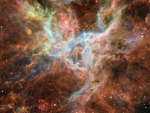 In the Heart of the Tarantula Nebula
31.03.2009
In the heart of monstrous Tarantula Nebula lies huge bubbles of energetic gas, long filaments of dark dust, and unusually massive stars. In the center of this heart, is a knot of stars so dense that it was once thought to be a single star.
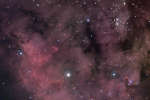 The Star Pillars of Sharpless 171
18.10.2009
Towering pillars of cold gas and dark dust adorn the center star forming region of Sharpless 171. An open cluster of stars is forming there from the gas in cold molecular clouds. As energetic...
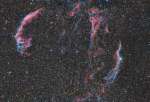 Wisps of the Veil Nebula
26.11.2012
Wisps like this are all that remain visible of a Milky Way star. About 9,000 years ago that star exploded in a supernova leaving the Veil Nebula, also known as the Cygnus Loop.
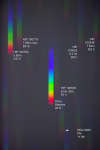 A Spectrum of Nova Delphini
23.08.2013
When a new star appeared in the constellation Delphinus late last week, astronomers found its spectrum hinted at the apparition's true nature. Now known as Nova Delphini, its visible light spectrum near maximum...
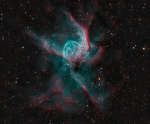 NGC 2359: Thor s Helmet
15.02.2014
This helmet-shaped cosmic cloud with wing-like appendages is popularly called Thor's Helmet. Heroically sized even for a Norse god, Thor's Helmet is about 30 light-years across. In fact, the helmet is more...
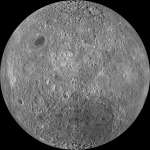 Lunar Farside
5.04.2014
Tidally locked in synchronous rotation, the Moon always presents its familiar nearside to denizens of planet Earth. From lunar orbit, the Moon's farside can become familiar, though. In fact this sharp picture, a mosaic from the Lunar Reconnaissance Orbiter's wide angle camera, is centered on the lunar farside.
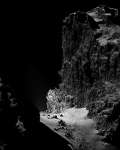 The Cliffs of Comet Churyumov Gerasimenko
22.12.2014
These high cliffs occur on the surface of a comet. They were discovered to be part of the dark nucleus of Comet ChuryumovGerasimenko (CG) by Rosetta, a robotic spacecraft launched by ESA which began orbiting the comet in early August. The ragged cliffs, as featured here, were imaged by Rosetta about two weeks ago.
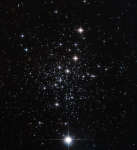 Palomar 12
18.02.2015
Palomar 12 was not born here. The stars of the globular cluster, first identified in the Palomar Sky Survey, are younger than those in other globular star clusters that roam the halo of our Milky Way Galaxy.
|
January February March April May June July August September |
|||||||||||||||||||||||||||||||||||||||||||||||||