
|
You entered: image
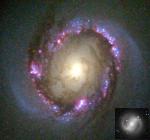 NGC 4314: A Nuclear Starburst Ring
12.12.1999
Is this old galaxy up to new tricks? The barred spiral galaxy NGC 4314 is billions of years old, but its appearance has changed markedly over just the past few millions of years. During that time, a nuclear ring of bright young stars has been evolving.
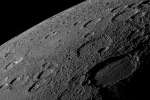 Mercurys Horizon from MESSENGER
21.01.2008
What would it look like to fly past Mercury? Just such an adventure was experienced last week by the MESSENGER spacecraft during its first flyby of the strange moon-like world nearest the Sun. Pictured above is the limb of Mercury seen by MESSENGER upon approach, from about 1 1/2 Earth diameters away.
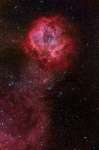 Long Stem Rosette
14.02.2008
The Rosette Nebula (aka NGC 2237) is not the only cosmic cloud of gas and dust to evoke the imagery of flowers. But it is the one most often suggested as a suitable astronomy image for Valentine's Day.
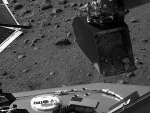 Mars Soil Sample Ready to Analyze
8.06.2008
What surprises are hidden in the soils of Mars? To help find out, the Phoenix Lander Phoenix Lander which arrived on Mars two weeks ago has attempted to place a scoop of soil in Phoenix's Thermal and Evolved-Gas Analyzer (TEGA). Pictured above, the dirt-filled scoop approaches one of TEGA's eight ovens.
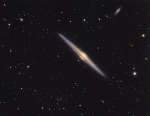 NGC 4565: Galaxy on Edge
4.03.2010
Magnificent spiral galaxy NGC 4565 is viewed edge-on from planet Earth. Also known as the Needle Galaxy for its narrow profile, bright NGC 4565 is a stop on many telescopic tours of the northern sky, in the faint but well-groomed constellation Coma Berenices.
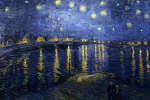 Starry Night Over the Rhone
21.09.2010
How can the majesty of the night sky best be captured in a painting? This was a continual challenge for Vincent van Gogh, a famous painter in the late 1800s who pioneered stirring depictions of star filled skies into several of his works.
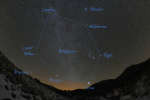 Winter Hexagon Over Stagecoach Colorado
3.01.2011
If you can find Orion, you might be able to find the Winter Hexagon. The Winter Hexagon involves some of the brightest stars visible, together forming a large and easily found pattern in the winter sky of Earth's northern hemisphere.
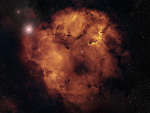 Monsters of IC 1396
25.04.2011
Is there a monster in IC 1396? Known to some as the Elephant's Trunk Nebula, parts of the glowing gas and dust clouds of this star formation region may appear to take on foreboding forms, some nearly human. The entire nebula might even look like a face of a monster.
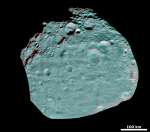 Stereo Vesta
20.08.2011
Get out your red/blue glasses and float next to 4 Vesta. A 500 kilometer diameter world, Vesta lies in the main asteroid belt between the orbits of Mars and Jupiter. This stereo anaglyph...
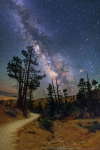 The Milky Trail
1.06.2013
Have you ever hiked the Queen's Garden trail in Bryce Canyon, Utah, USA, planet Earth? Walking along that path in this dark night skyscape, you can almost imagine your journey continues along the pale, luminous Milky Way.
|
January February March April May June July August September |
|||||||||||||||||||||||||||||||||||||||||||||||||