
|
You entered: Earth
 Comet SWAN Brightens
4.10.2006
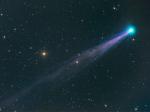
A newly discovered comet has brightened enough to be visible this week with binoculars. The picturesque comet is already becoming a favored target for northern sky imagers. Pictured above just last week, Comet SWAN showed a bright blue-green coma and an impressive tail.
 100 Hours of Astronomy Begins
2.04.2009
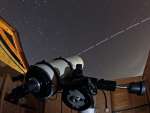
Today, 100 Hours of Astronomy begins, a cornerstone project of the International Year of Astronomy 2009 celebrating the 400th anniversary of Gallileo's original telescopic exploration of the sky. Running from April 2 through...
 Flowing Barchan Sand Dunes on Mars
20.04.2009
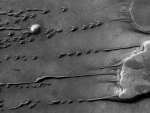
When does Mars act like a liquid? Although liquids freeze and evaporate quickly into the thin atmosphere of Mars, persistent winds may make large sand dunes appear to flow and even drip like a liquid.
 A Green Flash from the Sun
4.01.2011
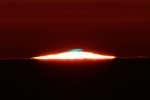
Many think it is just a myth. Others think it is true but its cause isn't known. Adventurers pride themselves on having seen it. It's a green flash from the Sun. The truth is the green flash does exist and its cause is well understood.
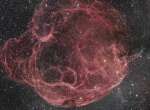 Simeis 147: Supernova Remnant
12.02.2011
It's easy to get lost following the intricate filaments in this detailed mosaic image of faint supernova remnant Simeis 147. Also cataloged as Sh2-240 and seen towards the constellation Taurus, it covers nearly 3 degrees (6 full moons) on the sky.
 Moon and Planets Over Catalonia
29.02.2012
Venus and Jupiter will appear unusually close in the sky over the next month. The planetary conjunction will be easily visible to the unaided eye because Venus will appear brighter than any background star, and Jupiter will be nearly as bright. To see the near-alignment, simply look to the west after sunset.
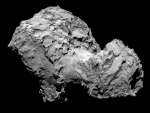 Rosetta s Rendezvous
7.08.2014
On August 3rd, the Rosetta spacecraft's narrow angle camera captured this stunning image of the nucleus of Comet 67P/Churyumov-Gerasimenko. After 10 years and 6.5 billion kilometers of travel along gravity assist trajectories looping through interplanetary space, Rosetta had approached to within 285 kilometers of its target.
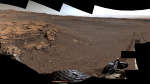 Curiosity at Teal Ridge
8.08.2019
Part of a 360 degree panorama, this view looks out from the Mars rover Curiosity's current location on the Red Planet dubbed Teal Ridge. The mosaicked scene was captured by the rover's Mastcam on Earth calendar date June 18, 2019.
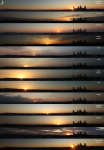 Solstice: Sunrises Around the Year
21.12.2020
Does the Sun always rise in the same direction? No. As the months change, the direction toward the rising Sun changes, too. The featured image shows the direction of sunrise every month during 2019 as seen from near the city of Amman, Jordan.
 Planetary Nebula Abell 7
7.03.2025
Very faint planetary nebula Abell 7 is about 1,800 light-years distant. It lies just south of Orion in planet Earth's skies toward the constellation Lepus, The Hare. Surrounded by Milky Way stars...
|
January February March April May June July August September October |
|||||||||||||||||||||||||||||||||||||||||||||||||