
|
You entered: planets
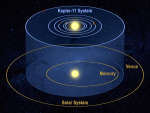 Six Worlds for Kepler 11
3.02.2011
Six worlds orbit Kepler-11, a sunlike star 2,000 light-years distant in the constellation Cygnus. The new discovery, based on data from NASA's planet hunting Kepler spacecraft, makes the Kepler-11 system the fullest exoplanetary system known.
 Gliese 581 and the Habitable Zone
26.04.2007
The faint, unremarkable star centered in this skyview is Gliese 581, a mere 20 light-years away toward the constellation Libra. But astronomers are now reporting the discovery of a remarkable system of three planets orbiting Gliese 581, including the most earth-like planet found beyond our solar system.
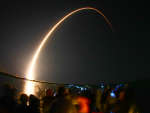 Kepler s Streak
9.03.2009
Streaking skyward, a Delta II rocket carries NASA's Kepler spacecraft aloft into the clear night of March 6. The dramatic scene was recorded in a time exposure from the crowded pier in Jetty Park at the northern end of Cocoa Beach, Florida, about 3 miles from the Cape Canaveral launch site.
 APOD: 2025 September 22 Б Equinox at Saturn
22.09.2025
On Saturn, the rings tell you the season. On Earth, today marks an equinox, the time when the Earth's equator tilts directly toward the Sun. Since Saturn's grand rings orbit along...
 APOD: 2025 September 25 Б Saturn Opposite the Sun
25.09.2025
This year Saturn was at opposition on September 21, opposite the Sun in planet Earth's sky. At its closest to Earth, Saturn was also at its brightest of the year, rising as the Sun set and shining above the horizon all night long among the fainter stars of the constellation Pisces.
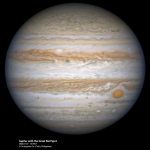 Jupiter with the Great Red Spot
10.01.2026
Jupiter reaches its 2026 opposition today, January 10. That puts our Solar System's most massive planet opposite the Sun and near its closest and brightest for viewing from planet Earth. In fact, captured...
 Equinox Earth
28.09.2013
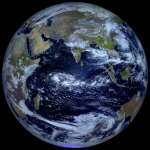
From a geostationary orbit 36,000 kilometers above the equator, Russian meteorological satellite Elektro-L takes high-resolution images our fair planet every 30 minutes. But only twice a year, during an Equinox, can it capture an image like this one, showing an entire hemisphere bathed in sunlight.
 Our Solar System from Voyager
14.12.1996
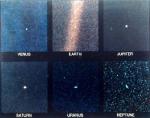
After taking spectacular pictures of our Solar System's outer planets, Voyager 1 looked back at six planets to take our Solar System's first family portrait. Here Venus, Earth, Jupiter, Saturn, Uranus, and Neptune, were all visible across the sky.
 APOD: 2025 October 5 Б A Long Storm System on Saturn
5.10.2025
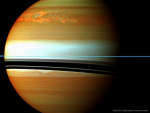
It was one of the largest and longest lived storms ever recorded in our Solar System. First seen in late 2010, the featured cloud formation in the northern hemisphere of Saturn started larger than the Earth and soon spread completely around the planet.
 Jupiter Swallows Comet Shoemaker Levy 9
4.08.1998
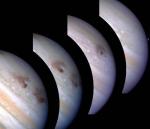
What happens when a comet encounters a planet? If the planet has a rocky surface, a huge impact feature will form. A giant planet like Jupiter, however, is mostly gas. When Comet Shoemaker-Levy 9 struck Jupiter in 1994, each piece was swallowed into the vast Jovian atmosphere.
|
January February March April May June July August September |
|||||||||||||||||||||||||||||||||||||||||||||||||