
|
You entered: launch
 The Race to Reveal Our Universe
9.05.2000
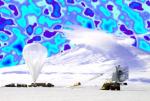
A race is underway to understand our universe through background radiation produced during its infancy. Observationally, increasingly accurate balloon experiments are pressing to beat future space-faring satellites to definitive measurements of universe-determining spot characteristics of the cosmic microwave background (CMB) radiation.
 The Horsehead Nebula in Infrared from Hubble
22.04.2013
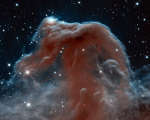
While drifting through the cosmos, a magnificent interstellar dust cloud became sculpted by stellar winds and radiation to assume a recognizable shape. Fittingly named the Horsehead Nebula, it is embedded in the vast and complex Orion Nebula (M42).
 Artemis I: Flight Day 13
31.01.2026
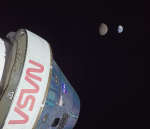
On flight day 13 (November 28, 2022) of the Artemis 1 mission, the Orion spacecraft reached its maximum distance from Earth. At over 430,000 kilometers from Earth, its distant retrograde orbit also puts Orion nearly 70,000 kilometers from the Moon.
 To the Moon
24.02.2024
Intuitive Machines' robotic lander Odysseus has accomplished the first U.S. landing on the Moon since the Apollo 17 mission in 1972. Launched on a SpaceX rocket on February 15, the phone booth sized lander reached lunar orbit on the 21st and touched down on the lunar surface at 6:23 pm ET on February 22nd.
 Saturn The Giant
25.05.2001
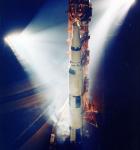
Forty years ago today (May 25, 1961) U.S. president John Kennedy announced the goal of landing Americans on the Moon by the end of the decade. Kennedy's ambitious speech triggered a nearly unprecedented peacetime technological mobilization and one result was the Saturn V moon rocket.
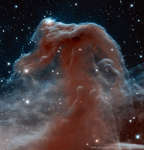 The Horsehead Nebula in Infrared from Hubble
8.06.2016
While drifting through the cosmos, a magnificent interstellar dust cloud became sculpted by stellar winds and radiation to assume a recognizable shape. Fittingly named the Horsehead Nebula, it is embedded in the vast and complex Orion Nebula (M42).
 APOD: 2024 December 16 Б A Kilometer High Cliff on Comet Churyumov Gerasimenko
16.12.2024
This kilometer high cliff occurs on the surface of a comet. It was discovered on the dark nucleus of Comet Churyumov - Gerasimenko (CG) by Rosetta, a robotic spacecraft launched by ESA, which orbited the comet from 2014 to 2016. The ragged cliff, as featured here, was imaged by Rosetta early in its mission.
 APOD: 2025 September 27 Б A Rocket in the Sun
27.09.2025
On the morning of September 24 a rocket crosses the bright solar disk in this long range telescopic snapshot captured from Orlando, Florida. That's about 50 miles north of its Kennedy Space Center launch site. This rocket carried three new space weather missions to space.
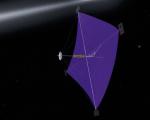 Solar Sail
26.05.2000
Nearly 400 years ago astronomer Johannes Kepler observed comet tails blown by a solar breeze and suggested that vessels might likewise navigate through space using appropriately fashioned sails. It is now widely recognized that...
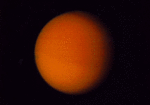 Titan: Saturn's Smog Moon
23.09.1995
The largest moon of Saturn is a rare wonder. Titan is the only one of Saturn's moons with an atmosphere, and one of only two moons in the Solar System with this distinction (Neptune's Triton is the other).
|
January February March April May |
|||||||||||||||||||||||||||||||||||||||||||||||||