
|
You entered: launch
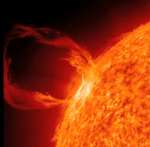 Large Eruptive Prominence Imaged by SDO
10.05.2010
Sometimes part of the Sun can just explode into space. These explosions might occur as powerful solar flares, coronal mass ejections, or comparatively tame eruptive solar prominences. Pictured above is one of the largest solar prominence eruptions yet observed, one associated with a subsequent coronal mass ejection.
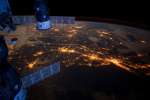 Yuri s Planet
12.04.2013
On another April 12th, in 1961, Soviet cosmonaut Yuri Alexseyevich Gagarin became the first human to see planet Earth from space. Commenting on his view from orbit he reported, "The sky is very dark; the Earth is bluish. Everything is seen very clearly".
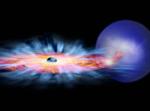 Wind from a Black Hole
1.07.2006
Binary star system GRO J1655-40 consists of a relatively normal star about twice as massive as the Sun co-orbiting with a black hole of about seven solar masses. This striking artist's vision of the exotic binary system helps visualize matter drawn from the normal star by gravity and swirling toward the black hole.
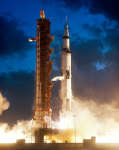 Saturn the Giant
9.11.2019
On May 25, 1961 U.S. president John Kennedy announced the goal of landing astronauts on the Moon by the end of the decade. By November 9, 1967 this Saturn V rocket was ready for launch and the first full test of its capabilities on the Apollo 4 mission.
 The Crew 7 Nebula
31.08.2023
Not the James Webb Space Telescope's latest view of a distant galactic nebula, this illuminated cloud of gas and dust dazzled early morning spacecoast skygazers on August 26. The snapshot was taken about...
 Terran 1 Burns Methalox
6.04.2023
Relativity's Terran 1 Rocket is mostly 3D-printed. It burns a cryogenic rocket fuel composed of liquid methane and liquid oxygen (methalox). In this close-up of a Terran 1 launch on the night...
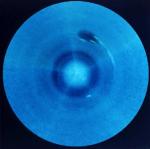 Southern Neptune
27.06.1998
Neptune, the Solar System's outermost gas giant planet, is 30 times farther from the Sun than Earth. Twelve years after a 1977 launch, Voyager 2 flew by Neptune and found surprising activity on a planet that receives only 3 percent as much sunlight as Jupiter.
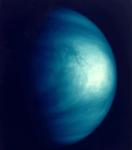 Venus: Just Passing By
12.06.1999
Venus, the second closest planet to the Sun, is a popular way-point for spacecraft headed for the gas giant planets in the outer reaches of the solar system. Why visit Venus first? Using...
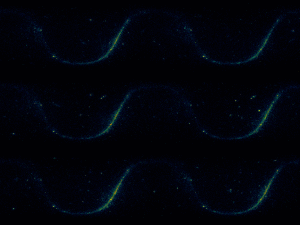 Simulated Gamma ray Sky
31.05.2006
Scheduled for launch in 2007, the Gamma-ray Large Area Space Telescope (GLAST) will explore the Universe in gamma-rays, the most energetic form of light. To get ready, consider this dynamic gamma-ray sky animation - constructed from simulating the first 55 days (seen above at one frame per day) of GLAST observations of cosmic gamma-ray sources.
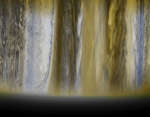 Jupiter's Clouds from New Horizons
23.10.2011
The New Horizons spacecraft took some stunning images of Jupiter on its way out to Pluto. Famous for its Great Red Spot, Jupiter is also known for its regular, equatorial cloud bands, visible through even modest sized telescopes.
|
January February March April May |
|||||||||||||||||||||||||||||||||||||||||||||||||