
|
You entered: stars
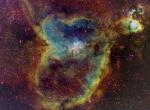 IC 1805: Light from the Heart
17.09.2004
Sprawling across hundreds of light-years, emission nebula IC 1805 is a mix of glowing interstellar gas and dark dust clouds. Only about 7,500 light-years away, stars were born in this region whose nickname - the Heart Nebula - derives from its suggestive shape (seen here sideways).
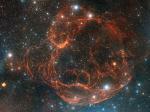 Simeis 147: Supernova Remnant from Palomar
29.11.2005
It's easy to get lost following the intricate filaments in this detailed image of faint supernova remnant Simeis 147. Seen towards the constellation Taurus it covers nearly 3 degrees (6 full moons) on the sky corresponding to a width of 150 light-years at the stellar debris cloud's estimated distance of 3,000 light-years.
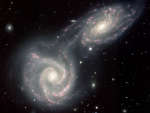 The Colliding Spiral Galaxies of Arp 271
21.07.2008
What will become of these galaxies? Spiral galaxies NGC 5426 and NGC 5427 are passing dangerously close to each other, but each is likely to survive this collision. Most frequently when galaxies collide, a large galaxy eats a much smaller galaxy.
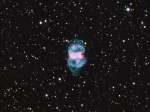 M76 Above and Below
21.11.2008
Also known by the popular name the "Little Dumbbell Nebula", M76 is one of the fainter objects listed in Charles Messier's 18th century Catalog of Nebulae and Star Clusters. Like its better-known namesake M27 (the Dumbbell Nebula), M76 is recognized as a planetary nebula - a gaseous shroud cast off by a dying sunlike star.
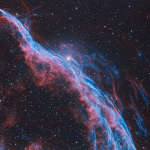 NGC 6960: The Witch s Broom Nebula
29.05.2013
Ten thousand years ago, before the dawn of recorded human history, a new light would have suddenly have appeared in the night sky and faded after a few weeks. Today we know this light was from a supernova, or exploding star, and record the expanding debris cloud as the Veil Nebula, a supernova remnant.
 The Long Jet of the Lighthouse Nebula
21.02.2014
The Lighthouse nebula was formed by the wind of a pulsar, a rapidly rotating, magnetized neutron star, as it speeds through the interstellar medium at over 1,000 kilometers per second. Some...
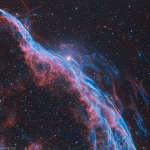 NGC 6960: The Witchs Broom Nebula
8.04.2018
Ten thousand years ago, before the dawn of recorded human history, a new light would have suddenly have appeared in the night sky and faded after a few weeks. Today we know this light was from a supernova, or exploding star, and record the expanding debris cloud as the Veil Nebula, a supernova remnant.
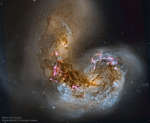 Spiral Galaxy NGC 4038 in Collision
23.05.2018
This galaxy is having a bad millennium. In fact, the past 100 million years haven't been so good, and probably the next billion or so will be quite tumultuous. Visible toward the lower...
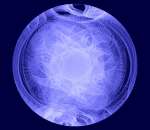 Fermi Epicyles: The Vela Pulsar s Path
4.05.2012
Exploring the cosmos at extreme energies, the Fermi Gamma-ray Space Telescope orbits planet Earth every 95 minutes. By design, it rocks to the north and then to the south on alternate orbits in order to survey the sky with its Large Area Telescope (LAT).
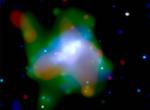 NGC 1569: Heavy Elements from a Small Galaxy
25.07.2002
For astronomers, elements other than hydrogen and helium are sometimes considered to be simply "heavy elements". It's understandable really, because even lumped all together heavy elements make up an exceedingly small fraction of the Universe. Still, heavy elements can profoundly influence galaxy and star formation ... not to mention the formation of planets and people.
|
January February March April May June July August September |
|||||||||||||||||||||||||||||||||||||||||||||||||