
|
You entered: stars
 In the Center of the Trifid Nebula
11.10.2015
Clouds of glowing gas mingle with dust lanes in the Trifid Nebula, a star forming region toward the constellation of the Archer (Sagittarius). In the center, the three prominent dust lanes that give the Trifid its name all come together.
 A Supernova through Galaxy Dust
23.02.2016
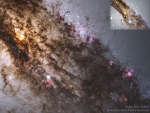
Telescopes around the world are tracking a bright supernova that occurred in a nearby dusty galaxy. The powerful stellar explosion was first noted earlier this month. The nearby galaxy is the photogenic Centaurus A, visible with binoculars and known for impressive filaments of light-absorbing dust that cross its center.
 A Laser Strike at the Galactic Center
6.01.2019
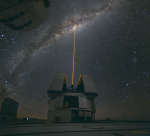
Why are these people shooting a powerful laser into the center of our Galaxy? Fortunately, this is not meant to be the first step in a Galactic war. Rather, astronomers at the Very Large Telescope (VLT) site in Chile are trying to measure the distortions of Earth's ever changing atmosphere.
 Solstice Sun and Milky Way
21.12.2021
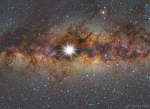
Welcome to December's solstice, first day of winter in the north and summer for the southern hemisphere. Astronomical markers of the seasons, solstice and equinox dates are based on the Sun's place in its annual journey along the ecliptic, through planet Earth's sky.
 A Gemini Sky
9.09.2003
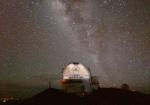
Where will Gemini take us tonight? It is dusk and Gemini North, one of the largest telescopes on planet Earth, prepares to peer into the distant universe. Gemini's flexible 8.1-mirror has taken...
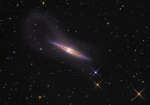 NGC 4013 and the Tidal Stream
7.02.2008
Nearly 50 million light-years away in the constellation Ursa Major, NGC 4013 was long considered an isolated island universe. Seen edge-on, the gorgeous spiral galaxy was known for its flattened disk and central bulge of stars, cut by silhouetted dust lanes.
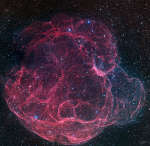 Simeis 147: Supernova Remnant
21.11.2019
It's easy to get lost following the intricate looping filaments in this detailed image of supernova remnant Simeis 147. Also cataloged as Sharpless 2-240 it goes by the popular nickname, the Spaghetti Nebula.
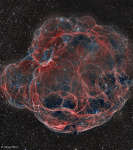 Simeis 147: Supernova Remnant
10.12.2020
It's easy to get lost following the intricate looping filaments in this detailed image of supernova remnant Simeis 147. Also cataloged as Sharpless 2-240 it goes by the popular nickname, the Spaghetti Nebula.
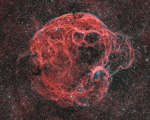 Supernova Remnant Simeis 147
13.01.2022
It's easy to get lost following the intricate, looping, twisting filaments in this detailed image of supernova remnant Simeis 147. Also cataloged as Sharpless 2-240 it goes by the popular nickname, the Spaghetti Nebula.
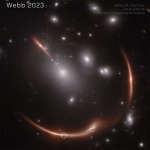 APOD: 2025 October 7 Б SN Encore: A Second Supernova Seen Several Times
7.10.2025
Now a second supernova in this same galaxy is repeating. The cause is the gravitational lens effect of a massive foreground cluster of galaxies (MACS J0138) -- it creates multiple images of a perfectly aligned background galaxy (MRG-M0138). What's particularly interesting is that this background galaxy has young stars that keep blowing up.
|
January February March April May June July August September |
|||||||||||||||||||||||||||||||||||||||||||||||||