
|
You entered: image
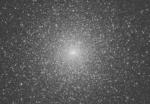 Globular Cluster M15
10.12.2001
Stars, like bees, swarm around the center of bright globular cluster M15. This ball of over 100,000 stars is a relic from the early years of our Galaxy, and continues to orbit the Milky Way's center.
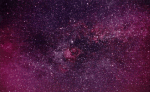 The Milky Way Near the Northern Cross
15.05.1996
This beautiful image of the sky near the bright star Deneb (just above center) reveals the stars, nebulae, and dark clouds along the plane of our Milky Way Galaxy as seen from the northern hemisphere (near Columbia Missouri, USA). Just below Deneb lies the suggestively shaped North American emission nebula.
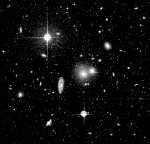 The Hydra Cluster of Galaxies
9.08.1997
You are flying through space and come to ... the Hydra Cluster of Galaxies. Listed as Abell 1060, the Hydra Cluster contains well over 100 bright galaxies. Clusters of galaxies are the largest gravitationally-bound objects in the universe.
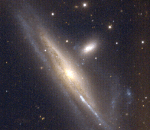 Interacting Galaxies
10.07.1998
This dramatic image of an interacting pair of galaxies was made using the 1.5 meter telescope at the Cerro Tololo Inter-American Observatory near La Serena, Chile. NGC 1531 is the background galaxy with a bright core just above center and NGC 1532 is the foreground spiral galaxy laced with dust lanes.
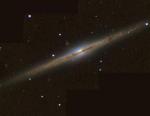 Edge On Spiral Galaxy NGC 891
20.12.1998
Is our Galaxy this thin? We believe so. The Milky Way, like NGC 891 pictured above, has the width of a typical spiral galaxy. Spirals have most of their bright stars, gas, and obscuring dust in a thin disk.
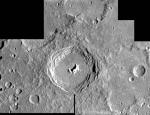 SMART 1: Pythagoras Crater
3.02.2005
Stark shadows show off the central peaks and terraced walls of 120 kilometer wide Pythagoras Crater in this mosaic of images from ESA's SMART-1 spacecraft. Characteristic of large, complex impact craters on the Moon, the central uplift was produced by a rebound of the suddenly molten lunar crust during the violent impact event.
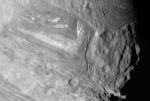 Miranda, Chevron, and Alonso
6.03.1999
Miranda is a bizarre world which surely had a tempestuous past. The innermost of the larger Uranian moons, Miranda is almost 300 miles in diameter and was discovered in 1948 by American planetary astronomer Gerard Kuiper.
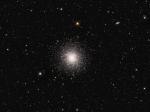 M13: The Great Globular Cluster in Hercules
18.05.2007
In 1714, Edmond Halley noted that M13 "shows itself to the naked eye when the sky is serene and the Moon absent." Of course, M13 is now modestly recognized as the Great Globular Cluster in Hercules, one of the brightest globular star clusters in the northern sky.
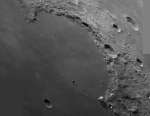 The Bay of Rainbows
8.02.2008
Dark, smooth regions that cover the Moon's familiar face are called by Latin names for oceans and seas. The naming convention is historical, though it may seem a little ironic to denizens...
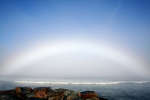 A Fog Bow Over Ocean Beach
29.05.2008
What is that white arch over the water? What is being seen is a fogbow, a reflection of sunlight by water drops similar to a rainbow but without the colors. The fog itself is not confined to an arch -- the fog is mostly transparent but relatively uniform.
|
January February March April May June July August September |
|||||||||||||||||||||||||||||||||||||||||||||||||