
|
You entered: dark
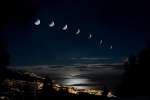 Eclipse at Moonset
29.12.2010
Hugging the horizon, a dark red Moon greeted early morning skygazers in eastern Atlantic regions on December 21, as the total phase of 2010's Solstice Lunar Eclipse began near moonset. This well composed...
 Young Stars, Stellar Jets
28.07.2023
High-speed outflows of molecular gas from a pair of actively forming young stars shine in infrared light, revealing themselves in this NIRcam image from the James Webb Space Telescope. Cataloged as HH (Herbig-Haro) 46/47, the young stars are lodged within a dark nebula that is largely opaque when viewed in visible light.
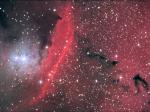 In the Center of NGC 6559
29.06.2004
Bright gas and dark dust permeate the space between stars in the center of a nebula known as NGC 6559. The gas, primarily hydrogen, is responsible for the diffuse red glow of the emission nebula.
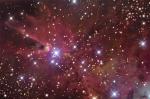 The Mysterious Cone Nebula
25.12.2005
Sometimes the simplest shapes are the hardest to explain. For example, the origin of the mysterious cone-shaped region seen on the far left remains a mystery. The interstellar formation, dubbed the Cone Nebula, is located about 2700 light years away.
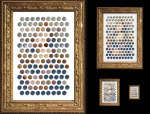 The Moona Lisa
16.10.2021
Only natural colors of the Moon in planet Earth's sky appear in this creative visual presentation. Arranged as pixels in a framed image, the lunar disks were photographed at different times. Their varying hues are ultimately due to reflected sunlight affected by changing atmospheric conditions and the alignment geometry of Moon, Earth, and Sun.
 The Moona Lisa
14.09.2024
Only natural colors of the Moon in planet Earth's sky appear in this creative visual presentation. Arranged as pixels in a framed image, the lunar disks were photographed at different times. Their varying hues are ultimately due to reflected sunlight affected by changing atmospheric conditions and the alignment geometry of Moon, Earth, and Sun.
 The Sun Changes
13.04.1998
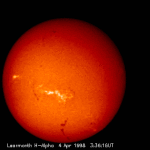
Our Sun changes every day. This recent picture was taken in a very specific red color called Hydrogen-Alpha. Dark spots that might appear on the image are usually sunspots, dark magnetic depressions that are slightly cooler than the rest of the Sun's surface.
 Annular Eclipse Over Myanmar
26.01.2010
A hole crossed the Sun for a few minutes this month, as seen across a thin swath of planet Earth. The event on January 15 was actually an annular solar eclipse, and the hole was really Earth's Moon, an object whose dark half may appear even darker when compared to the tremendously bright Sun.
 Earthshadow and the Beehive
3.02.2018
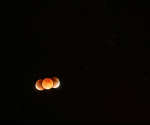
The Earth's dark umbral shadow is shaped like a cone extending into space. Of course its circular cross section at the distance of the Moon is more easily seen during a lunar eclipse.
 Striped Sand Dunes on Mars
6.01.2021
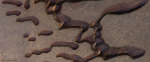
Why are these sand dunes on Mars striped? No one is sure. The featured image shows striped dunes in Kunowsky Crater on Mars, photographed recently with the Mars Reconnaissance OrbiterБs HiRISE Camera. Many Martian dunes are known to be covered unevenly with carbon dioxide (dry ice) frost, creating patterns of light and dark areas.
|
January February March April May June July August September |
|||||||||||||||||||||||||||||||||||||||||||||||||