
|
You entered: dark
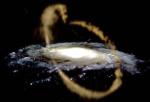 The Sagittarius Dwarf Tidal Stream
29.05.2005
Is our Milky Way Galaxy out to lunch? Recent wide field images and analyses now indicate that our home galaxy is actually still in the process of devouring one of its closer satellite neighbors.
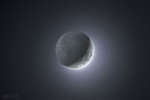 APOD: 2020 August 24 Б Crescent Moon HDR
24.08.2020
How come the crescent Moon doesn't look like this? For one reason, because your eyes can't simultaneously discern bright and dark regions like this. Called earthshine or the da Vinci glow...
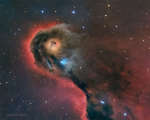 APOD: 2025 October 14 Б An Unusual Globule in IC 1396
14.10.2025
Is there a monster in IC 1396? Known to some as the Elephant's Trunk Nebula, parts of gas and dust clouds of this star formation region may appear to take on foreboding forms, some nearly human. The only real monster here, however, is a bright young star too far from Earth to hurt us.
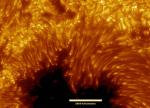 The Sharpest View of the Sun
14.11.2002
This stunning image shows remarkable and mysterious details near the dark central region of a planet-sized sunspot in one of the sharpest views ever of the surface of the Sun. Just released, the picture was made using the Swedish Solar Telescope now in its first year of operation on the Canary Island of La Palma.
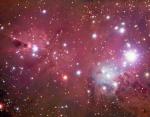 The Mysterious Cone Nebula
7.01.2002
Sometimes the simplest shapes are the hardest to explain. For example, the origin of the mysterious cone-shaped region seen on the far left remains a mystery. The interstellar formation, dubbed the Cone Nebula, is located about 2700 light years away.
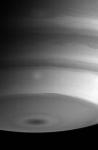 Southern Saturn from Cassini
18.10.2004
What happens to Saturn's pervasive clouds at its South Pole? Visible in the above image of Saturn are bright bands, dark belts and a dark spot right over the South Pole. The above...
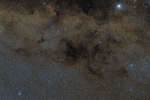 Rigil Kentaurus and Sandqvist 169
13.04.2019
Rigil Kentaurus is the bright star near the top of this broad southern skyscape. Of course it's probably better known as Alpha Centauri, nearest star system to the Sun. Below it sprawls a dark nebula complex.
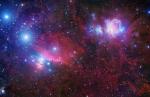 The Orion Deep Field
6.01.2007
Adrift 1,500 light-years away in one of the night sky's most recognizable constellations, the glowing Orion Nebula and the dark Horsehead Nebula are contrasting cosmic vistas. But even fainter filaments of glowing...
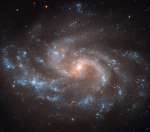 NGC 5584: Expanding the Universe
30.03.2011
Big, beautiful NGC 5548 is more that 50,000 light-years across and lies 72 million light-years away toward the constellation Virgo. The winding spiral arms of this gorgeous island universe are loaded with luminous young star clusters and dark dust lanes. Still, for earthbound astronomers NGC 5548 is not just another pretty face-on spiral galaxy.
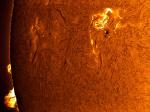 Sunspot 875 Flares
2.05.2006
An unusually active sunspot region is now crossing the Sun. The region, numbered 875, is larger than the Earth and has produced several solar flares over the past week. It should take a few more days for Sunspot 875 to finish crossing the solar disk.
|
January February March April May June July August September |
|||||||||||||||||||||||||||||||||||||||||||||||||