
|
You entered: Voyager
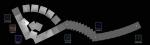 A Solar System Portrait
5.05.1999
As the Voyager 1 spacecraft headed out of our Solar System, it looked back and took a parting family portrait of the Sun and planets. From beyond Pluto, our Solar System looks like a bright star surrounded by faint dots. In the above picture, the Sun is so bright it is blocked out for contrast.
 A Trip to the Moon
13.01.2014
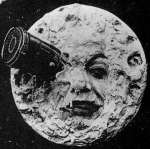
What would it be like to visit the Moon? The first major fictional cinematic film exploring this enduring transcultural fantasy was titled Le voyage dans la lune (A Trip to the Moon) and made in 1902, becoming one of the most popular movies of the early years of the twentieth century.
 The Pale Blue Dot
14.02.2020
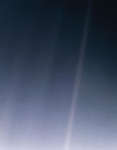
On Valentine's Day in 1990, cruising four billion miles from the Sun, the Voyager 1 spacecraft looked back one last time to make the first ever Solar System family portrait. The portrait consists...
 Triton: Neptune's Largest Moon
10.10.1996
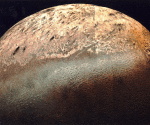
Today marks the 150th anniversary of the discovery of Triton. On October 10 1846, William Lassell was observing the newly discovered planet Neptune. He was attempting to confirm his observation, made just the previous week, that Neptune had a ring. But this time he discovered that Neptune had a satellite as well.
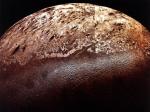 Triton: Neptunes Largest Moon
4.03.2007
In October of 1846, William Lassell was observing the newly discovered planet Neptune. He was attempting to confirm his observation, made just the previous week, that Neptune had a ring. But this time he discovered that Neptune had a satellite as well.
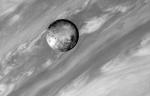 5 Million Miles From Io
11.03.1999
Twenty years ago this month, NASA's Voyager 1 spacecraft flew past Jupiter and its moons. This sharp picture of moon Io against a background of gas giant Jupiter's diffuse swirling cloud bands was recorded by Voyager's camera from a distance of about 5 million miles.
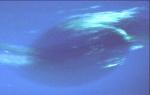 Neptune's Great Dark Spot: Gone But Not Forgotten
1.12.2001
When NASA's Voyager 2 spacecraft flew by distant Neptune in August of 1989, astronomers were shocked. Since Neptune receives only 3 percent the sunlight Jupiter does, they expected to find a dormant, dark, frigid planet. Instead, the Voyager images revealed evidence of a dynamic and turbulent world.
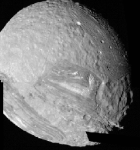 Uranus' Moon Miranda
24.12.1995
NASA's robot spacecraft Voyager 2 passed the planet Uranus and its moons in 1986. While the cloud tops of Uranus proved to be rather featureless, the surface of Miranda, the innermost of Uranus' large moons, showed several interesting features.
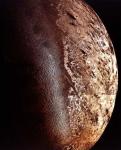 Triton: Neptune's Largest Moon
10.10.1999
One hundred and fifty three years ago, on October 10th, 1846, William Lassell was observing the newly discovered planet Neptune. He was attempting to confirm his observation, made just the previous week, that Neptune had a ring. But this time he discovered that Neptune had a satellite as well.
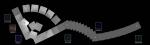 Solar System Portrait
14.02.2002
On another Valentine's Day (February 14, 1990), cruising four billion miles from the Sun, the Voyager 1 spacecraft looked back to make this first ever family portrait of our Solar System. The complete portrait is a 60 frame mosaic made from a vantage point 32 degrees above the ecliptic plane.
|
January February March April May June July August September October |
|||||||||||||||||||||||||||||||||||||||||||||||||