
|
You entered: Stardust
 Asteroid Annefrank
13.11.2002
NASA's interplanetary probe STARDUST, on its way to Comet Wild 2 in January 2004, passed asteroid 5535 Annefrank earlier this month. Annefrank, named for a holocaust victim who kept a famous diary, is a member of the main asteroid belt between Mars and Jupiter.
 Help Search for Interstellar Dust
25.10.2006
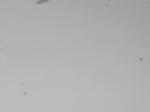
What caused that hole? The hole in question appears as a small dark circle on the far right. If the above image of aerogel seems dull and uninteresting, then welcome to one aspect of real world science.
 Unusual Spires Found on Comet Wild 2
22.06.2004
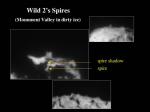
How did unusual spires form on comet Wild 2? Close inspection of images taken of Comet Wild 2 by the passing Stardust spacecraft in January show numerous strange pinnacles as long as 100 meters long jutting off the surface. The pinnacles were unexpected - close-ups of other comets and asteroids show no such features.
 Going Wild
19.03.2004
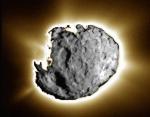
Dynamic jets of gas and dust surround one of the most active planetary surfaces in the solar system in this wild-looking picture of a comet nucleus. The comet's designation is 81P/Wild...
 A Piece of Interplanetary Dust
13.08.2001
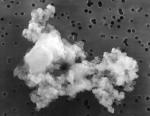
The dust that pervades our Solar System is not the dust that pervades our homes. Solar System dust comes from comets and asteroids, whereas house dust is most likely lint or dead cells. Pictured above is a piece of interplanetary dust caught by a high-flying U2-type aircraft.
 Meteors Now and Again
10.08.1998
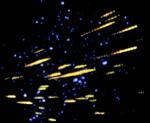
The Perseid Meteor Shower, usually the best meteor shower of the year, will peak over the next two nights. Over the course of an hour, a person watching a clear sky from a dark location might see as many as 100 meteors.
 Bright Comet SOHO
21.05.1998
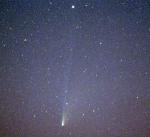
Discovered this month with an orbiting solar observatory, bright Comet SOHO has now emerged from the Sun's glare. This telephoto picture of the new naked-eye comet was taken by astrophotographer Michael Horn after sunset in the western twilight above Lake Samsonvale, Brisbane, Australia on May 18. The comet is seen in the constellation Orion.
 Young Star Cluster NGC 1333
12.09.2024
This spectacular mosaic of images from the James Webb Space Telescope peers into the heart of young star cluster NGC 1333. A mere 1,000 light-years distant toward the heroic constellation Perseus, the nearby star cluster lies at the edge of the large Perseus molecular cloud.
 NGC 1333: Stellar Nursery in Perseus
11.11.2021
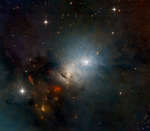
NGC 1333 is seen in visible light as a reflection nebula, dominated by bluish hues characteristic of starlight reflected by interstellar dust. A mere 1,000 light-years distant toward the heroic constellation Perseus, it lies at the edge of a large, star-forming molecular cloud.
 NGC 1333: Stellar Nursery in Perseus
30.01.2026
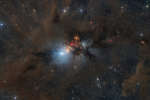
NGC 1333 is seen in visible light as a reflection nebula, dominated by bluish hues characteristic of starlight reflected by interstellar dust. A mere 1,000 light-years distant toward the heroic constellation Perseus, it lies at the edge of a large, star-forming molecular cloud.
|
January February March April May June July August September |
|||||||||||||||||||||||||||||||||||||||||||||||||