
|
You entered: Stardust
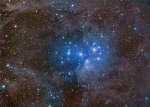 Pleiades and Stardust
14.10.2009
Have you ever seen the Pleiades star cluster? Perhaps the most famous star cluster on the sky, the Pleiades can be seen without binoculars from even the depths of a light-polluted city. Also known as the Seven Sisters and M45, the Pleiades is one of the brightest and closest open clusters.
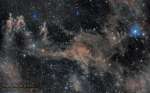 Stardust in Aries
9.12.2017
This composition in stardust covers over 8 degrees on the northern sky. The mosaicked field of view is west of the familiar Pleiades star cluster, toward the zodiacal constellation Aries and the plane of our Milky Way Galaxy.
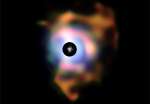 Stardust and Betelgeuse
28.06.2011
An expansive nebula of dust is seen to surround red supergiant star Betegeuse in this remarkable high resolution composite, an infrared VLT image from the European Southern Observatory. Betelgeuse itself is outlined by the small, central red circle. If found in our own solar system its diameter would almost encompass the orbit of Jupiter.
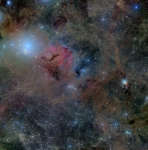 Stardust in Perseus
12.01.2023
This cosmic expanse of dust, gas, and stars covers some 6 degrees on the sky in the heroic constellation Perseus. At upper left in the gorgeous skyscape is the intriguing young star cluster IC 348 and neighboring Flying Ghost Nebula with clouds of obscuring interstellar dust cataloged as Barnard 3 and 4.
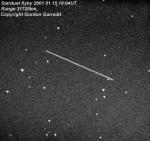 Sail On Stardust
25.01.2001
Spacecraft on long interplanetary voyages often use the planets themselves as gravitational "sling shots" to boost them along their way. Launched in February of 1999 on a historic voyage to a comet, the Stardust spacecraft is no different.
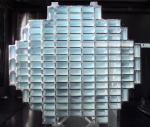 Aerogel For Stardust
18.02.1999
On February 7th, this honey comb of aluminum cells filled with aerogel was launched on the STARDUST mission to interplanetary space. STARDUST's goal is to capture dust from a comet's tail and return to planet Earth - the first sample return mission to a comet!
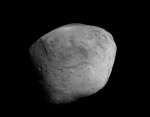 Comet Tempel 1 from Stardust NeXT Spacecraft
16.02.2011
No comet has ever been visited twice before. Therefore, the unprecedented pass of the Stardust-NeXT spacecraft near Comet Tempel 1 earlier this week gave humanity a unique opportunity to see how the nucleus of a comet changes over time.
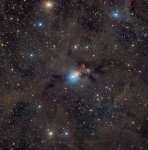 Stardust in the Perseus Molecular Cloud
18.03.2021
Clouds of stardust drift through this deep skyscape, across the Perseus molecular cloud some 850 light-years away. Dusty nebulae reflecting light from embedded young stars stand out in the nearly 2 degree wide telescopic field of view.
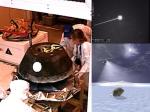 Stardust Capsule Returns to Earth
16.01.2006
A flying saucer from outer space crash-landed in the Utah desert yesterday after being tracked by radar and chased by helicopters and airplanes. Like last time, no space aliens were involved. The saucer...
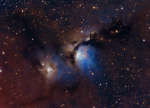 Stardust and Starlight in M78
8.03.2019
Interstellar dust clouds and bright nebulae abound in the fertile constellation of Orion. One of the brightest, M78, is near the center in this colorful telescopic view, covering an area north of Orion's belt. At a distance of about 1,500 light-years, the bluish nebula itself is about 5 light-years across.
|
January February March April May June July August September |
|||||||||||||||||||||||||||||||||||||||||||||||||