
|
You entered: image
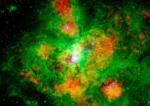 30 Doradus Across the Spectrum
24.12.1997
30 Doradus is lit up like a Christmas tree. Shining in light across the electromagnetic spectrum, 30 Doradus glows because of all the energetic processes that go on there. A distinctive region visible...
 The View from Everest
31.08.2003
What would it be like to stand atop the tallest mountain on Earth? To see a full panoramic vista from there, scroll right. Visible are snow peaked mountains near and far, tremendous cliffs, distant plateaus, the tops of clouds, and a dark blue sky. Mt.
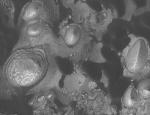 Layered Hills on Mars
24.12.2003
Why are some hills on Mars so layered? The answer is still under investigation. Clearly, dark windblown sand surrounds outcropping of light sedimentary rock across the floor of crater Arabia Terra. The light rock clearly appears structured into many layers, the lowest of which is likely very old.
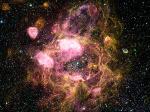 N11: A Giant Ring of Emission Nebulas
6.10.2004
How did this unusually large nebula form? One of the largest nebulas yet detected is actually a complex ring of emission nebulas connected by glowing filaments. The unusual network, known as N11, spans over...
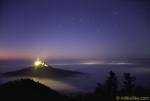 Big Dipper Castle
18.02.2005
The stars of the big dipper, a well known asterism in the constellation Ursa Major, are easy to recognize in this dramatic skyscape. In fact, northern hemisphere skygazers often follow along the line indicated by the two stars at the far right.
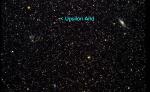 Where is Upsilon Andromedae
22.04.1999
Astronomers recently announced the detection of three large planets orbiting the star Upsilon Andromedae - the first planetary system known to orbit a normal star other than our Sun. These planets were not directly photographed but found through a Doppler technique developed to use large telescopes to search nearby stars for wobbling planetary signatures.
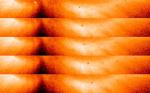 X ray Transit of Mercury
6.11.1999
This sequence of false color X-ray images captures a rare event - the passage or transit of planet Mercury in front of the Sun. Mercury's small disk is silhouetted against the bright background of X-rays from the hot Solar Corona.
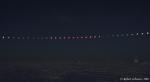 South Pole Lunar Eclipse
7.09.2007
The Moon was up continuously for 14 days in August -- when viewed from the South Pole. But during the total lunar eclipse on August 28, it circled only about 10 degrees above the horizon.
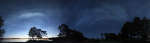 Noctilucent Cloud Storm Panorama
11.07.2009
Noctilucent or night-shining clouds lie near the edge of space. From about 80 kilometers above Earth's surface, the icy clouds can still reflect sunlight even though the Sun itself is below the horizon as seen from the ground.
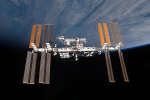 The International Space Station Over the Horizon
7.12.2009
This was home. Just over a week ago, the STS-129 crew of the Space Shuttle Atlantis undocked from the International Space Station (ISS) and returned to Earth. As the shuttle departed the space station, they took the above image. Visible on the ISS are numerous modules, trusses, and long wing-like solar panels.
|
January February March April May June July August September |
|||||||||||||||||||||||||||||||||||||||||||||||||