
|
You entered: image
 APOD: 2024 March 20 Б The Eyes in Markarians Galaxy Chain
20.03.2024
Across the heart of the Virgo Galaxy Cluster lies a string of galaxies known as Markarian's Chain. Prominent in Markarian's Chain are these two interacting galaxies, NGC 4438 (left) and NGC 4435 - also known as The Eyes.
 APOD: 2025 February 10 Б Auroral Hummingbird over Norway
10.02.2025
Is this the largest hummingbird ever? Although it may look like a popular fluttering nectarivore, what is pictured is actually a beautifully detailed and colorful aurora, complete with rays reminiscent of feathers. This aurora...
 Barred Spiral Galaxy NGC 5335
26.04.2025
This stunning portrait of NGC 5335 was captured by the Hubble Space Telescope. Some 170,000 light-years across and over 200 million light-years away toward the constellation Virgo, the magnificent spiral galaxy is seen face-on in Hubble's view.
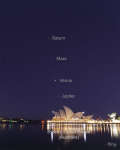 APOD: 2026 February 24 Б Planet Parade over Sydney Opera House
24.02.2026
Look up this week and see a whole bunch of planets. Just after sunset, looking west (mostly), planets Mercury, Venus, Saturn, and Jupiter will all be visible to the unaided eye simultaneously. If you have a telescope, planets Uranus and Neptune can also be seen.
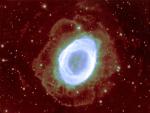 Halos Around the Ring Nebula
22.09.1999
What's happened to the Ring Nebula? The familiar Ring that can be seen with a small back-yard telescope takes on a new look when viewed in dim light. The above recently-released, false-color image...
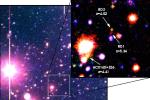 A Baby Galaxy
24.03.1998
What's the farthest galaxy known? The answer keeps changing as astronomers compete to find new galaxies which top the list. The new record holder is now the faint red smudge indicated in the above image by the arrow.
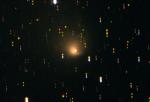 Comet Hale Bopp in the Outer Solar System
26.03.2001
Whatever became of Comet Hale-Bopp? The brightest comet in recent years has continued into the outer Solar System and is now further from the Sun than Saturn. To the surprise of many, Comet Hale-Bopp is still active, continuing to spew gas, ice and dust particles out into space.
 Hot Gas Halo Detected Around Galaxy NGC 4631
25.07.2001
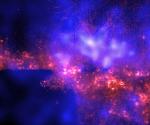
Is our Milky Way Galaxy surrounded by a halo of hot gas? A step toward solving this long-standing mystery was taken recently with Chandra X-ray observations of nearby galaxy NGC 4631. In the above composite picture, newly resolved diffuse X-ray emission is shown in blue, superposed on a HST image showing massive stars in red.
 The View from Everest
23.07.2002
What would it be like to stand atop the tallest mountain on Earth? To see a full panoramic vista from there, scroll right. Visible are snow peaked mountains near and far, tremendous cliffs, distant plateaus, the tops of clouds, and a dark blue sky. Mt.
 Planetary Systems Now Forming in Orion
7.12.1996
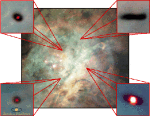
How do planets form? Astronomers are finding out by studying one of the most interesting of all astronomical nebulae known, the Great Nebula in Orion. Insets to above mosaic show several planetary systems in formation. The bottom left insert shows the relative size of our own Solar System. The Orion Nebula contains many stellar nurseries.
|
January February March April May June July August September |
|||||||||||||||||||||||||||||||||||||||||||||||||