
|
You entered: phase
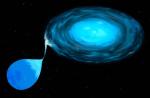 Accretion Disk Binary System
19.12.1999
Our Sun is unusual in that it is alone - most stars occur in multiple or binary systems. In a binary system, the higher mass star will evolve faster and will eventually become a compact object - either a white dwarf star, a neutron star, or black hole.
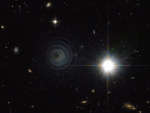 An Extraordinary Spiral from LL Pegasi
14.09.2010
What created the strange spiral structure on the left? No one is sure, although it is likely related to a star in a binary star system entering the planetary nebula phase, when its outer atmosphere is ejected.
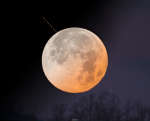 Full Moon, Full Mars
15.12.2022
On December 8 a full Moon and a full Mars were close, both bright and opposite the Sun in planet Earth's sky. In fact Mars was occulted, passing behind the Moon when viewed from some locations across Europe and North America.
 APOD: 2024 November 12 Б NGC 6888: The Crescent Nebula
12.11.2024
How was the Crescent Nebula created? Looking like an emerging space cocoon, the Crescent Nebula, visible in the center of the featured image, was created by the brightest star in its center. A leading progenitor hypothesis has the Crescent Nebula beginning to form about 250,000 years ago.
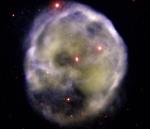 NGC 246 and the Dying Star
18.04.2006
Appropriately nicknamed "the Skull Nebula", planetary nebula NGC 246 really does surround a dying star some 1,600 light-years away in the constellation Cetus. Expelled over a period of thousands of years, the lovely, intricate nebula is the outer atmosphere of a once sun-like star.
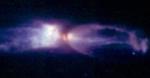 The Rotten Egg Planetary Nebula
1.11.1999
Not all evolving stars eject gas clouds that look like people. OH231.8+4.2 was a star much like our Sun that ran out of nuclear fuel to fuse in its core.
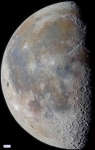 Craters and Shadows at the Lunar Terminator
22.05.2018
Why does the right part of this image of the Moon stand out? Shadows. The terminator line -- the line between light and dark -- occurs in the featured image so that just over half the Moon's face is illuminated by sunlight.
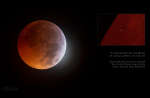 Moon Struck
25.01.2019
Craters produced by ancient impacts on the airless Moon have long been a familiar sight. But only since the 1990s have observers began to regularly record and study optical flashes on the lunar surface, likely explosions resulting from impacting meteoroids. Of course, the flashes are difficult to see against a bright, sunlit lunar surface.
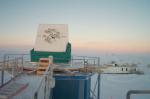 Antarctica Hears Little Matter in the Big Bang
1.05.2001
On the frozen tundra near the bottom of our world, increasingly sophisticated instruments listen for a more precise echo of how our universe started. Sunday, independent collaborations behind three such instruments announced evidence that...
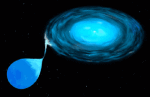 Accretion Disk Binary System
26.12.1995
Our Sun is unusual in that it is alone - most stars occur in multiple or binary systems. In a binary system, the higher mass star will evolve faster and will eventually become a compact object - either a white dwarf star, a neutron star, or black hole.
|
January February March April May June July August |
||||||||||||||||||||||||||||||||||||||||||||||||||||||||