
|
You entered: phase
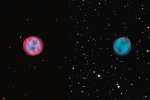 Northern and Southern Owls
6.05.2010
Captured in colorful telescopic portraits, two cosmic owls glare back toward planet Earth in this intriguing comparison of planetary nebulae. On the left is M97 in the constellation Ursa Major, also known in the northern hemisphere as the Owl Nebula.
 APOD: 2023 December 25 Б Cathedral, Mountain, Moon
25.12.2023
Single shots like this require planning. The first step is to realize that such an amazing triple-alignment actually takes place. The second step is to find the best location to photograph it. But it was the third step: being there at exactly the right time -- and when the sky was clear -- that was the hardest.
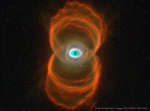 MyCn18: An Hourglass Planetary Nebula
10.05.2015
The sands of time are running out for the central star of this hourglass-shaped planetary nebula. With its nuclear fuel exhausted, this brief, spectacular, closing phase of a Sun-like star's life occurs as its outer layers are ejected - its core becoming a cooling, fading white dwarf.
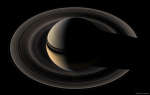 Crescent Saturn
7.07.2019
Saturn never shows a crescent phase -- from Earth. But when viewed from beyond, the majestic giant planet can show an unfamiliar diminutive sliver. This image of crescent Saturn in natural color was taken by the robotic Cassini spacecraft in 2007.
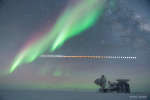 Lunar Eclipse at the South Pole
5.11.2022
Last May 16 the Moon slid through Earth's shadow, completely immersed in the planet's dark umbra for about 1 hour and 25 minutes during a total lunar eclipse. In this composited timelapse...
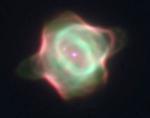 Hen 1357: New Born Nebula
6.10.2001
This Hubble Space Telescope snapshot shows Hen-1357, the youngest known planetary nebula. Graceful, gentle curves and symmetry suggest its popular name - The Stingray Nebula. Observations in the 1970s detected no nebular material, but this image from March 1996 clearly shows the Stingray's emerging bubbles and rings of shocked and ionized gas.
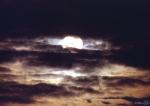 Partial Eclipse, Cloudy Day
21.12.2001
Welcome to the December Solstice, first day of winter in the north and summer in the southern hemisphere of planet Earth. Today the Sun reaches its southernmost declination in the sky at 19:21 Universal Time.
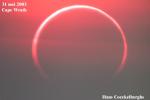 Ring of Fire from Cape Wrath
5.06.2003
If the Moon's apparent diameter is not quite large enough to cover the Sun during a solar eclipse, an annular eclipse can be the result -- a spectacle of silhouetted Moon surrounded by a solar "ring of fire".
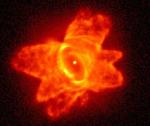 PKS285 02: A Young Planetary Nebula
22.06.1999
How do planetary nebulae acquire their exquisite geometrical shapes? To investigate this, astronomers used the Hubble Space Telescope to image several young planetary nebulae. These nebulae are the outer envelopes of stars like our Sun that have recently been cast away to space, leaving behind a core fading to become a white dwarf.
 APOD: 2023 June 12 Б The Largest Satellites of Earth
12.06.2023
WhatБs that near the Moon? ItБs the International Space Station (ISS). Although the ISS may appear to be physically near the Moon, it is not Б it is physically near the Earth.
|
January February March April May June July August September October November |
||||||||||||||||||||||||||||||||||||||||||||||||||||||||