
|
You entered: rotation
 Noctilucent Clouds Over Germany
24.06.2009
Sometimes it's night on the ground but day in the air. As the Earth rotates to eclipse the Sun, sunset rises up from the ground. Therefore, at sunset on the ground, sunlight still shines on clouds above.
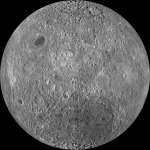 Lunar Farside
9.04.2011
Tidally locked in synchronous rotation, the Moon always presents its familiar nearside to denizens of planet Earth. From lunar orbit, the Moon's farside can become familiar, though. In fact this sharp picture, a mosaic from the Lunar Reconnaissance Orbiter's wide angle camera, is centered on the lunar farside.
 Rosetta Approaches Comet Churyumov Gerasimenko
11.08.2014
What does it look like to approach a comet? Early this month humanity received a new rendition as the robotic Rosetta spacecraft went right up to -- and began orbiting -- the nucleus of Comet 67P/Churyumov-Gerasimenko.
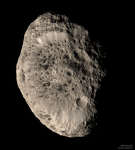 Saturns Hyperion in Natural Color
14.05.2018
What lies at the bottom of Hyperion's strange craters? To help find out, the robot Cassini spacecraft now orbiting Saturn swooped past the sponge-textured moon in 2005 and 2010 and took images of unprecedented detail.
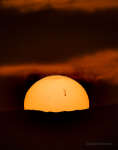 APOD: 2026 February 8 Б Active Sunspot Region 4366 Crosses the Sun
8.02.2026
An unusually active sunspot region is now crossing the Sun. The region, labelled AR 4366, is much larger than the Earth and has produced several powerful solar flares over the past ten days. In the featured image, the region is marked by large and dark sunspots toward the upper right of the Sun's disk.
 The Milky Way Over the Arizona Toadstools
22.02.2015
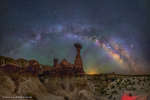
Which is older -- the rocks you see on the ground or the light you see from the sky? Usually its the rocks that are older, with their origin sentiments deposited well before light left any of the stars or nebulas you see in the sky.
 Mimas, Crater, and Mountain
11.01.2017
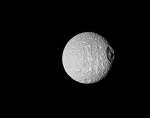
Mimas is an icy, crater-pocked moon of Saturn a mere 400 kilometers (250 miles) in diameter. Its largest crater Herschel is nearly 140 kilometers wide. About a third the diameter of Mimas itself, Herschel crater gives the small moon an ominous appearance, especially for scifi fans of the Death Star battlestation of Star Wars fame.
 AR 9169: A Large Sunspot
25.09.2000
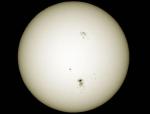
One of the largest sunspots in recent years is now crossing our Sun. Dominating active region AR 9169, the sunspot is the large dark complex visible below (west) and right of center in the above photograph of our Sun taken last Thursday.
 The North and South Jupiter
14.09.2016
A wide, looping orbit brought Juno close to Jupiter on August 27. As the spacecraft swung around the giant planet's poles JunoCam acquired these premier direct polar views, a change from the usual nearly equatorial perspective of outbound spacecraft and the telescopes of planet Earth.
 Gemini North Images Bow Shock Near Galactic Center
17.10.2000
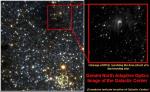
What's going on near the center of our Galaxy? Glowing across the electromagnetic spectrum, the center of our Milky Way Galaxy is thought to be home to massive stars, rotating gas rings, and a massive black hole. Now the central Galactic zoo just got larger.
|
January February March April May |
|||||||||||||||||||||||||||||||||||||||||||||||||