
|
You entered: planets
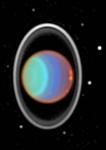 Uranian Moons, Rings, And Clouds
26.11.1997
The giant planet Uranus is faint and featureless when viewed in visible light. But this pair of near-infrared mosaics from the Hubble Space Telescope's NICMOS camera reveals moons, rings, and clouds of this distant gas planet.
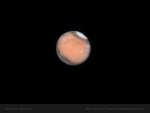 Mars Opposition 2010
29.01.2010
Mars is at opposition tonight, opposite the Sun in planet Earth's sky. Of course, it will be easy to spot because Mars appears close to tonight's Full Moon, also opposite the Sun in Earth's night sky in the constellation Cancer.
 The Reappearance of Mars
11.09.2020
Mars reappears just beyond the Moon's dark limb in this stack of sharp video frames captured on September 6. Of course to reappear it had to disappear in the first place.
 Mars 2020 from 5,000 Feet
31.07.2020
On Thursday this snapshot from a small plane 5,000 feet above Florida's Space Coast caught a rocket's trail rising into the blue morning sky. It was July's third launch of a mission from planet Earth bound for Mars.
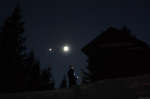 Alpine Conjunction
2.01.2009
Did you see it? The last conjunction of Moon and bright planets in 2008 featured a young crescent Moon and brilliant Venus in the west after sunset on December 31st. Seen here in dark, clear, mountain air from Mönichkirchen, Austria, are the two celestial beacons that dominate planet Earth's night sky.
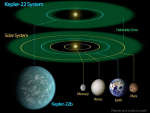 APOD: 2011 December 7 Kepler 22b: An Almost Earth Orbiting an Almost Sun
7.12.2011
Its the closest match to Earth that has yet been found. Recently discovered planet Kepler 22b has therefore instantly become the best place to find life outside our Solar System. The planet's host...
 Aphelion Sunrise
5.07.2017
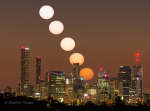
On July 3rd, planet Earth reached aphelion, the farthest point in its elliptical orbit around the Sun. Each year, this day of the most distant Sun happens to occur during winter in the southern hemisphere.
 APOD: 2026 May 6 Б The Retrograde Dance of Saturn and Neptune
6.05.2026
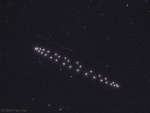
What does it mean for Saturn and Neptune to be in retrograde? Featured is a composite of images taken over 34 nights from May 2025 to February 2026 tracing Saturn (brighter, foreground) and Neptune (dimmer, background). Over that time, the two planets exhibited retrograde motion, meaning they appeared to move backward in the sky.
 Jupiter, Io, and Shadow
7.12.2002
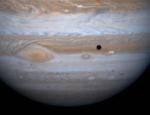
Pictured above is the innermost of Jupiter's Galilean satellites, Io, superposed in front of the gas giant planet. To the left of Io is a dark spot that is Io's own shadow. A solar eclipse would be seen from within the shadow spot on Jupiter.
 Crescent Saturn
23.10.2007
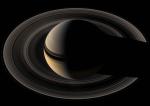
Saturn never shows a crescent phase -- from Earth. But when viewed from beyond, the majestic giant planet can show an unfamiliar diminutive sliver. This image of crescent Saturn in natural color was taken by the robotic Cassini spacecraft in May.
|
January February March April May June July August September |
|||||||||||||||||||||||||||||||||||||||||||||||||