
|
You entered: optical
 Sibling Supernova Remnants
1.07.2026
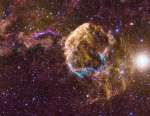
What happens when one of the stars in a binary goes supernova? This image combines visible (yellow), ultraviolet (purple) and infrared light (cyan, red and orange) to show two supernova remnants and their surrounding environment, about 6,000 light-years away. The younger one is the well-known Jellyfish Nebula in the center (mostly in yellow).
 X Ray Stars in M15
20.09.2001
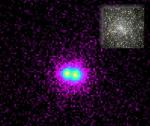
Side by side, two x-ray stars greeted astronomers in this false-color Chandra Observatory x-ray image of a region near the core of globular star cluster M15. The greeting was a pleasant surprise, as all previous x-ray images of the cluster showed only one such source where Chandra's sharper x-ray vision now reveals two.
 X-Rays from the Galactic Plane
14.08.2001
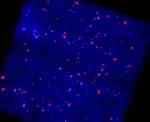
In February 2000, the orbiting Chandra X-ray Observatory spent 27 hours staring into the plane of our Milky Way galaxy. Its target was a spot in the small constellation Scutum, within the Milky Way's zone of avoidance where galactic gas and dust clouds block visible light, making a poor window for optical telescopes.
 Mizar Binary Star
18.02.1997
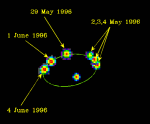
Mizar (sounds like "My Czar") is a binary star. In fact, most stars are binary stars. In a binary star system, each star of the pair follows an elliptical orbital path. Mutual gravity causes...
 Moon Struck
7.12.1999
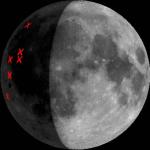
Craters produced by ancient impacts on the airless Moon have long been a familiar sight. But now observers have seen elusive optical flashes on the lunar surface - likely the fleeting result of impacting meteoroids. Orchestrated by David Dunham, president of the International Occultation
 A Powerful Gamma Ray Burst
7.05.1998
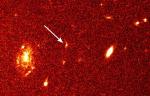
Gamma-ray bursts are thought to be the most powerful explosions in the Universe, yet the cause of these high-energy flashes remains a mystery. Blindingly bright for space-based gamma-ray detectors the burst sources are so faint at visible wavelengths that large telescopes and sensitive cameras are required to search for them.
 High Energy Stereoscopic System II
27.07.2012
The largest of its kind, the High Energy Stereoscopic System (H.E.S.S.) II telescope stands in the foreground of this photo. Tilted horizontally it reflects the inverted landscape of the Namibian desert in a segmented mirror 24 meters wide and 32 meters tall, equal in area to two tennis courts.
 APOD: 2025 August 24 Б The Spinning Pulsar of the Crab Nebula
23.08.2025
At the core of the Crab Nebula lies a city-sized, magnetized neutron star spinning 30 times a second. Known as the Crab Pulsar, it is the bright spot in the center of the gaseous swirl at the nebula's core.
 Centaurus As Warped Magnetic Fields
20.04.2021
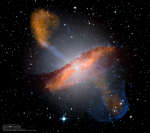
When galaxies collide -- what happens to their magnetic fields? To help find out, NASA pointed SOFIA, its flying 747, at galactic neighbor Centaurus A to observe the emission of polarized dust -- which traces magnetic fields.
 GW200115: Simulation of a Black Hole Merging with a Neutron Star
13.07.2021
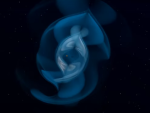
What happens when a black hole destroys a neutron star? Analyses indicate that just such an event created gravitational wave event GW200115, detected in 2020 January by LIGO and Virgo observatories. To better understand the unusual event, the featured visualization was created from a computer simulation.
|
January February March April May June July August September |
|||||||||||||||||||||||||||||||||||||||||||||||||