
|
You entered: optical
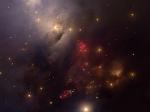 In the Center of Reflection Nebula NGC 1333
21.05.2007
The dust is so thick in the center of NGC 1333 that you can hardly see the stars forming. Conversely, the very dust clouds that hide the stars also reflects their optical light, giving NGC 1333's predominantly blue glow the general designation of a reflection nebula.
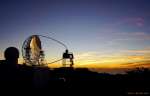 Cherenkov Telescope at Sunset
18.10.2018
On October 10, a new telescope reflected the light of the setting Sun. With dark horizon above and sunset colors below, its segmented mirror inverts an image of the beautiful evening sky in this snapshot from the Roque del Los Muchachos Observatory on the Canary Island of La Palma.
 APOD: 2024 July 2 Б NGC 602: Oyster Star Cluster
2.07.2024
The clouds may look like an oyster, and the stars like pearls, but look beyond. Near the outskirts of the Small Magellanic Cloud, a satellite galaxy some 200 thousand light-years distant, lies this 5 million year old star cluster NGC 602.
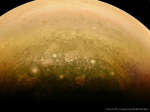 Clouds Near Jupiters South Pole from Juno
25.10.2016
What's happening near the south pole of Jupiter? Recent images sent back by NASA's robotic Juno spacecraft are showing an interesting conglomeration of swirling clouds and what appear to be white ovals.
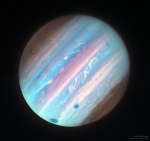 Jupiter in Ultraviolet from Hubble
16.10.2018
Jupiter looks a bit different in ultraviolet light. To better interpret Jupiter's cloud motions and to help NASA's robotic Juno spacecraft understand the planetary context of the small fields that it sees, the Hubble Space Telescope is being directed to regularly image the entire Jovian giant.
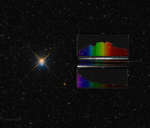 Beautiful Albireo AB
24.02.2022
Beta Cygni is a single bright star to the naked eye. About 420 light-years away it marks the foot of the Northern Cross, famous asterism in the constellation Cygnus. But a view through...
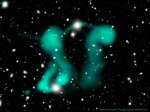 Dancing Ghosts: Curved Jets from Active Galaxies
1.09.2021
Why would galaxies emit jets that look like ghosts? And furthermore, why do they appear to be dancing? The curled and fluffy jets from the supermassive black holes at the centers of two host galaxies (top center and lower left) are unlike anything seen before.
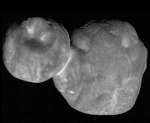 Sharpest Ultima Thule
28.02.2019
On January 1, New Horizons swooped to within 3,500 kilometers of the Kuiper Belt world known as Ultima Thule. That's about 3 times closer than its July 2015 closest approach to Pluto.
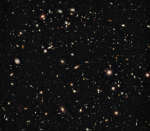 HUDF Infrared: Dawn of the Galaxies
9.12.2009
When did galaxies form? To help find out, the deepest near-infrared image of the sky ever has been taken of the same field as the optical-light Hubble Ultra Deep Field (HUDF) in 2004. The new image was taken this summer by the newly installed Wide Field Camera 3 on the refurbished Hubble Space Telescope.
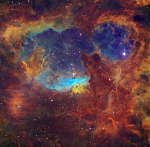 Massive Stars in NGC 6357
5.02.2016
Massive stars lie within NGC 6357, an expansive emission nebula complex some 6,500 light-years away toward the tail of the constellation Scorpius. In fact, positioned near center in this ground-based close-up...
|
January February March April May June July August September |
|||||||||||||||||||||||||||||||||||||||||||||||||