
|
You entered: Saturn
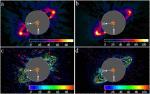 HR 4796A: Not Saturn
5.02.1999
These are not false-color renderings of the latest observations of Saturn's magnificent rings. Instead, the panels show a strikingly similar system on a much larger scale - a ring around the young, Vega-like star, HR 4796A, located about 200 light-years from Earth.
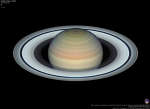 Saturn near Opposition
17.06.2017
Saturn reached its 2017 opposition on June 16. Of course, opposition means opposite the Sun in Earth's sky and near opposition Saturn is up all night, at its closest and brightest for the year.
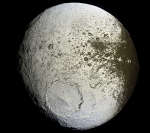 Saturns Iapetus: Painted Moon
9.08.2009
What has happened to Saturn's moon Iapetus? Vast sections of this strange world are dark as coal, while others are as bright as ice. The composition of the dark material is unknown, but infrared spectra indicate that it possibly contains some dark form of carbon.
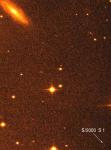 New Moons For Saturn
3.11.2000
Which planet has the most moons? For now, it's Saturn. Four newly discovered satellites bring the ringed planet's total to twenty-two, just edging out Uranus' twenty-one for the most known moons in the solar system. Of course, the newfound Saturnian satellites are not large and photogenic.
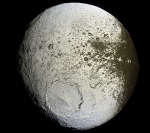 Saturns Iapetus: Painted Moon
13.01.2012
What has happened to Saturn's moon Iapetus? Vast sections of this strange world are dark as coal, while others are as bright as ice. The composition of the dark material is unknown, but infrared spectra indicate that it possibly contains some dark form of carbon.
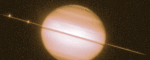 Crossing The Ring Plane
1.08.1995
"I do not know what to say in a case so surprising, so unlooked for and so novel." announced Galileo when Saturn's rings appeared to vanish in 1612. In fact, every 15 years Saturn's rings seem to almost disappear as viewed from the Earth.
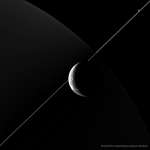 APOD: 2015 July 8 In the Company of Dione
8.07.2015
That is not our Moon. It's Dione, and its a moon of Saturn. The robotic Cassini spacecraft took the featured image during a flyby of Saturn's cratered Moon last month. Perhaps what makes this image so interesting, though, is the background.
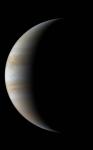 Farewell Jupiter
8.08.2001
Next stop: Saturn. The Cassini spacecraft, launched from Earth four years ago, has now swung past Jupiter and should arrive at Saturn in the year 2004. Pictured to the left is a parting shot from Cassini in January that would not have been possible from Earth: Jupiter showing a crescent phase.
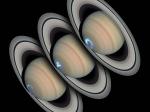 Persistent Saturnian Auroras
22.02.2005
Are Saturn's auroras like Earth's? To help answer this question, the Hubble Space Telescope and the Cassini spacecraft monitored Saturn's South Pole simultaneously as Cassini closed in on the gas giant in January 2004. Hubble snapped images in ultraviolet light, while Cassini recorded radio emissions and monitored the solar wind.
 Persistent Saturnian Auroras
22.06.2014
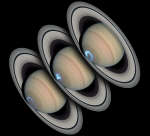
Are Saturn's auroras like Earth's? To help answer this question, the Hubble Space Telescope and the Cassini spacecraft monitored Saturn's South Pole simultaneously as Cassini closed in on the gas giant in January 2004. Hubble snapped images in ultraviolet light, while Cassini recorded radio emissions and monitored the solar wind.
|
January February March April May June July August September October |
|||||||||||||||||||||||||||||||||||||||||||||||||