
|
You entered: Saturn
 Stereo Helene
1.06.2024
Get out your red/blue glasses and float next to Helene, small, icy moon of Saturn. Appropriately named, Helene is a Trojan moon, so called because it orbits at a Lagrange point. A Lagrange point is a gravitationally stable position near two massive bodies, in this case Saturn and larger moon Dione.
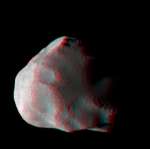 Stereo Helene
29.03.2025
Get out your red/blue glasses and float next to Helene, small, icy moon of Saturn. Appropriately named, Helene is a Trojan moon, so called because it orbits at a Lagrange point. A Lagrange point is a gravitationally stable position near two massive bodies, in this case Saturn and larger moon Dione.
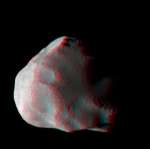 Stereo Helene
15.06.2019
Get out your red/blue glasses and float next to Helene, small, icy moon of Saturn. Appropriately named, Helene is one of four known Trojan moons, so called because it orbits at a Lagrange point. A Lagrange point is a gravitationally stable position near two massive bodies, in this case Saturn and larger moon Dione.
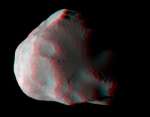 Stereo Helene
23.06.2011
Get out your red/blue glasses and float next to Helene, small, icy moon of Saturn. Appropriately named, Helene is one of four known Trojan moons, so called because it orbits at a Lagrange point. A Lagrange point is a gravitationally stable position near two massive bodies, in this case Saturn and larger moon Dione.
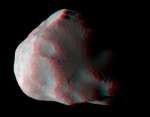 Stereo Helene
5.01.2013
Get out your red/blue glasses and float next to Helene, small, icy moon of Saturn. Appropriately named, Helene is one of four known Trojan moons, so called because it orbits at a Lagrange point. A Lagrange point is a gravitationally stable position near two massive bodies, in this case Saturn and larger moon Dione.
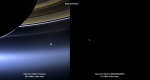 Two Views of Earth
23.07.2013
In a cross-Solar System interplanetary first, our Earth was photographed during the same day from both Mercury and Saturn. Pictured on the left, Earth is the pale blue dot just below the rings of Saturn, as captured by the robotic Cassini spacecraft now the gas giant.
 Ring Scan
24.10.2007
Scroll right and cruise above the thin, icy rings of Saturn. This high resolution scan is a mosaic of images presented in natural color and recorded in May, over about 2.5 hours as the Cassini spacecraft passed above the unlit side of the rings.
 Between the Rings
22.04.2017
On April 12, as the Sun was blocked by the disk of Saturn the Cassini spacecraft camera looked toward the inner Solar System and the gas giant's backlit rings. At the top of the mosaicked view is the A ring with its broader Encke and narrower Keeler gaps visible.
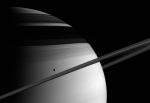 Tethys, Rings, and Shadows
22.07.2005
Seen from ice moon Tethys, rings and shadows would play across fantastic views of the Saturnian system. Haven't dropped in on Tethys lately? Then this gorgeous ringscape from the Cassini spacecraft will have to do for now.
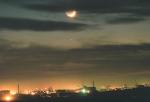 Moon Over Mongolia
16.09.1997
Fighting clouds and the glow of city lights, a young Moon shines over the western horizon of Mongolia's capital Ulaan-Baatar. The thin sunlit crescent is 1.5 days old and strongly over exposed in this image taken on March 10.
|
January February March April May June July August September October |
|||||||||||||||||||||||||||||||||||||||||||||||||