
|
You entered: image
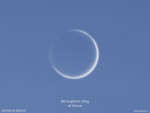 Atmospheric Ring of Venus
8.06.2020
Why is Venus surrounded by a bright ring? Sometimes called a ring of fire, this rare ring is caused by the Sun's light being visible all around an object. Usually seen around...
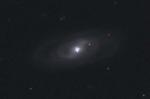 The Einstein Cross Gravitational Lens
10.10.2000
Most galaxies have a single nucleus -- does this galaxy have four? The strange answer leads astronomers to conclude that the nucleus of the surrounding galaxy is not even visible in this image. The central cloverleaf is rather light emitted from a background quasar.
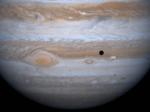 Jupiter, Io, and Shadow
26.12.2000
Just as planets orbit our Sun, Jupiter's Moons orbit Jupiter. Pictured above is the closest of Jupiter's Galilean Satellites, Io, superposed in front of the giant planet it circles. To the left of Io is a dark spot that is its own shadow.
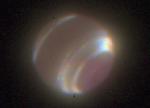 Neptune through Adaptive Optics
18.02.2000
From the Earth's surface, Neptune usually appears as a fuzzy blotch. The blurring effects of the Earth's atmosphere deny clearer images. By distorting mirrors in the telescope itself in time with the changing atmosphere, however, these effects can be greatly reduced.
 Odysseus on the Moon
2.03.2024
Methalox rocket engine firing, Odysseus' landing legs absorb first contact with the lunar surface in this wide-angle snapshot from a camera on board the robotic Intuitive Machines Nova-C moon lander. Following the landing on February 22, broken landing legs, visible in the image, ultimately left the lander at rest but tilted.
 A Partial Solar Eclipse over Texas
22.05.2012
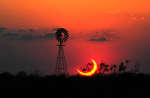
It was a typical Texas sunset except that most of the Sun was missing. The location of the missing piece of the Sun was not a mystery -- it was behind the Moon. Sunday night's partial eclipse of the Sun by the Moon turned into one of the best photographed astronomical events in history.
 M16: Pillars of Creation
22.07.2012
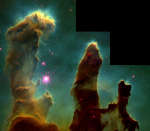
It was one of the most famous images of the 1990s. This image, taken with the Hubble Space Telescope in 1995, shows evaporating gaseous globules (EGGs) emerging from pillars of molecular hydrogen gas and dust. The giant pillars are light years in length and are so dense that interior gas contracts gravitationally to form stars.
 Pluto in Enhanced Color
31.08.2015
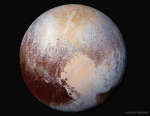
Pluto is more colorful than we can see. Color data and images of our Solar System's most famous dwarf planet, taken by the robotic New Horizons spacecraft during its flyby in July, have been digitally combined to give an enhanced view of this ancient world sporting an unexpectedly young surface.
 Pluto from above Cthulhu Regio
14.09.2015
New high resolution images of Pluto are starting to arrive from the outer Solar System. The robotic New Horizons spacecraft, which zoomed by Pluto in July, has finished sending back some needed engineering data and is now transmitting selections from its tremendous storehouse of images of Pluto and its moons.
 The Space Station Crosses a Spotless Sun
28.10.2019
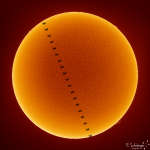
Typically, the International Space Station is visible only at night. Slowly drifting across the night sky as it orbits the Earth, the International Space Station (ISS) can be seen as a bright spot about once a month from many locations.
|
January February March April May June July August September |
|||||||||||||||||||||||||||||||||||||||||||||||||