
|
You entered: image
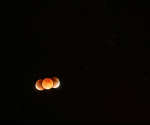 Earthshadow and the Beehive
3.02.2018
The Earth's dark umbral shadow is shaped like a cone extending into space. Of course its circular cross section at the distance of the Moon is more easily seen during a lunar eclipse.
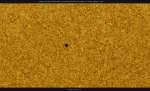 Mercury in Silhouette
13.11.2019
The small, dark, round spot in this solar close up is planet Mercury. In the high resolution telescopic image, a colorized stack of 61 sharp video frames, a turbulent array of photospheric convection cells tile the bright solar surface. Mercury's more regular silhouette still stands out though.
 APOD: 2023 October 30 Б Reflections of the Ghost Nebula
30.10.2023
Do any shapes seem to jump out at you from this interstellar field of stars and dust? The jeweled expanse, filled with faint, starlight-reflecting clouds, drifts through the night in the royal constellation of Cepheus.
 APOD: 2024 April 10 Б Planets Around a Total Eclipse
10.04.2024
What wonders appear when the Moon blocks the Sun? For many eager observers of MondayБs total eclipse of the Sun, the suddenly dark sky included the expected corona and two (perhaps surprise) planets: Venus and Jupiter.
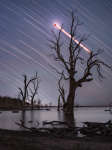 APOD: 2026 March 13 Б Toolondo Totality Trails
13.03.2026
In this composited night skyscape, stacked exposures trace graceful star trails above Lake Toolondo, Victoria, Australia, planet Earth. Captured while the lunar eclipse of March 3 was in progress, the exposures used were made during the hour-long total eclipse phase.
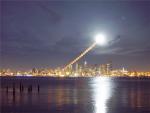 Moonrise Over Seattle
30.01.2002
Is the Moon larger when near the horizon? No -- as shown above, the Moon appears to be very nearly the same size no matter its location on the sky. Oddly, the cause or causes for the common Moon Illusion are still being debated.
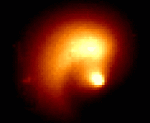 Comet Hale-Bopp Update
30.10.1995
Will comet Hale-Bopp become the brightest comet of the Century in early 1997? Since its discovery in July this year, Hale-Bopp has caused much speculation. Even though it is still beyond the orbit of Jupiter it is astonishingly bright and expected to get much brighter as it plunges inward, toward the Sun.
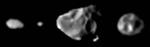 Jupiter's Inner Moons
27.11.1997
The potato-shaped inner moons of Jupiter are lined-up in this mosaic "family portrait" of these tiny Jovian satellites. The individual images were recorded over the last year by NASA's Galileo spacecraft and are scaled to the moons' relative sizes.
 A Flock of Stars
13.12.2003
Only a few stars can be found within ten light-years of our lonely Sun, situated near an outer spiral arm of the Milky Way galaxy. But if the Sun were found within one of our galaxy's star clusters, thousands of stars might occupy a similar space.
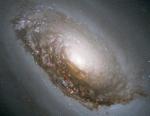 M64: The Sleeping Beauty Galaxy
11.02.2004
The Sleeping Beauty galaxy may appear peaceful at first sight but it is actually tossing and turning. In an unexpected twist, recent observations have shown that the gas in the outer regions of this photogenic spiral is rotating in the opposite direction from all of the stars!
|
January February March April May June July August September |
|||||||||||||||||||||||||||||||||||||||||||||||||