
|
You entered: image
 A Chicago Meteorite Fall
24.07.2005
If you wait long enough, a piece of outer space itself will come right to you. As Colby Navarro worked innocently on the computer, a rock from space crashed through the roof, struck the printer, banged off the wall, and came to rest near the filing cabinet.
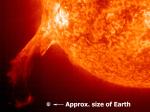 An Erupting Solar Prominence from SOHO
7.08.2006
Our Sun is still very active. In the year 2000, our Sun went though Solar Maximum, the time in its 11-year cycle where the most sunspots and explosive activities occur. Sunspots, the Solar Cycle, and solar prominences are all caused by the Sun's changing magnetic field.
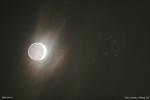 Young Moon and Sister Stars
28.04.2007
A young crescent Moon shared the western sky with thin clouds and the sister stars of the Pleiades cluster in this early evening skyscape recorded on April 19th. Astronomical images of the well-known Pleiades often show the star cluster's alluring blue reflection nebulae, but they are washed-out here in the clouds and bright moonlight.
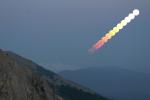 Great Mountain Moonrise
7.06.2007
On May 31st, a gorgeous Full Moon rose over Uludag Mountain in Bursa Province, Turkey. This alluring telephoto view of the twilight scene is a composite of images taken roughly every two minutes beginning shortly after Sunset, following the rising Moon as it moves up and to the right.
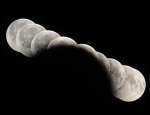 Earth s Shadow
20.08.2008
The dark, inner shadow of planet Earth is called the umbra. Shaped like a cone extending into space, the umbra has a circular cross section that can be most easily seen during a lunar eclipse. For example, last Saturday the Full Moon slid across the northern edge of the umbra.
 Annular Eclipse Over Myanmar
26.01.2010
A hole crossed the Sun for a few minutes this month, as seen across a thin swath of planet Earth. The event on January 15 was actually an annular solar eclipse, and the hole was really Earth's Moon, an object whose dark half may appear even darker when compared to the tremendously bright Sun.
 Mangaia's Milky Way
24.09.2011
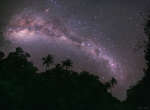
From Sagittarius to Carina, the Milky Way Galaxy shines in this dark night sky above planet Earth's lush island paradise of Mangaia. Familiar to denizens of the southern hemisphere, the gorgeous skyscape includes the bulging galactic center at the upper left and bright stars Alpha and Beta Centauri just right of center.
 The Heart and Soul Nebulas
11.02.2014
Is the heart and soul of our Galaxy located in Cassiopeia? Possibly not, but that is where two bright emission nebulas nicknamed Heart and Soul can be found. The Heart Nebula, officially dubbed IC 1805 and visible in the above zoomable view on the right, has a shape reminiscent of a classical heart symbol.
 Comet Lovejoy before a Globular Star Cluster
30.12.2014
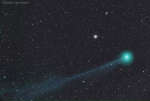
Comet Lovejoy has become visible to the unaided eye. To see the comet, just go outside an hour or so after sunset and look for a fuzzy patch to the right of Orion's belt. Binoculars and a star chart may help.
 In Green Company: Aurora over Norway
10.12.2017
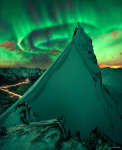
Raise your arms if you see an aurora. With those instructions, two nights went by with, well, clouds -- mostly. On the third night of returning to same peaks, though, the sky not only cleared up but lit up with a spectacular auroral display.
|
January February March April May June July August September |
|||||||||||||||||||||||||||||||||||||||||||||||||