
|
You entered: radio
 APOD: 2024 April 1 Б Swirling Magnetic Field around Our Galaxys Central Black Hole
1.04.2024
What's happening to the big black hole in the center of our galaxy? It is sucking in matter from a swirling disk -- a disk that is magnetized, it has now been confirmed. Specifically, the black hole's accretion disk has recently been seen to emit polarized light, radiation frequently associated with a magnetized source.
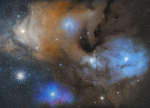 The Colorful Clouds of Rho Ophiuchi
3.12.2013
The many spectacular colors of the Rho Ophiuchi (oh'-fee-yu-kee) clouds highlight the many processes that occur there. The blue regions shine primarily by reflected light. Blue light from the star Rho Ophiuchi and nearby stars reflects more efficiently off this portion of the nebula than red light.
 APOD: 2024 May 15 Б AR 3664 at the Suns Edge
15.05.2024
What did the monster active region that created the recent auroras look like when at the Sun's edge? There, AR 3664 better showed its 3D structure. Pictured, a large multi-pronged solar prominence...
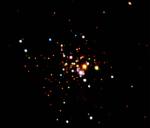 X Ray Stars of 47 Tuc
21.07.2005
Visible light images show the central region of globular cluster 47 Tucanae is closely packed, with stars less than a tenth of a light-year apart. This Chandra false-color x-ray view of central...
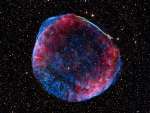 SN 1006 Supernova Remnant
1.08.2009
A new star, likely the brightest supernova in recorded human history, lit up planet Earth's sky in the year 1006 AD. The expanding debris cloud from the stellar explosion, found in the southerly constellation of Lupus, still puts on a cosmic light show across the electromagnetic spectrum.
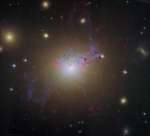 Hubble Remix: Active Galaxy NGC 1275
6.10.2013
Active galaxy NGC 1275 is the central, dominant member of the large and relatively nearby Perseus Cluster of Galaxies. Wild-looking at visible wavelengths, the active galaxy is also a prodigious source of x-rays and radio emission.
 A Panorama of Oddities in Orion A
13.03.2000
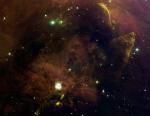
New stars, fast jets, and shocked gas clouds all occupy Orion A, a giant molecular cloud just south of the Orion Nebula. The bright object visible below and slightly left of center of this recently released picture is the reflection nebula NGC 1999.
 The Colorful Clouds of Rho Ophiuchi
3.09.2007
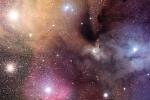
The many spectacular colors of the Rho Ophiuchi (oh'-fee-yu-kee) clouds highlight the many processes that occur there. The blue regions shine primarily by reflected light. Blue light from the star Rho Ophiuchi and nearby stars reflects more efficiently off this portion of the nebula than red light.
 Afterglow
28.05.1998
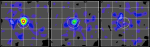
This sequence of three false color X-ray pictures from the Italian/Dutch BeppoSAX satellite follows the fading glow from a gamma-ray burster. This burster triggered orbiting gamma-ray observatories on December 14, 1997 and within 6.5 hours the sensitive X-ray cameras onboard BeppoSAX had been turned to record the first image (left) of the afterglow.
 A Raging Storm System on Saturn
28.04.2013
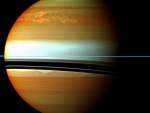
It was one of the largest and longest lived storms ever recorded in our Solar System. First seen in late 2010, the above cloud formation in the northern hemisphere of Saturn started larger than the Earth and soon spread completely around the planet.
|
January February March April May June July August September |
|||||||||||||||||||||||||||||||||||||||||||||||||