
|
You entered: phases
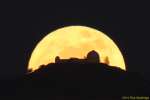 Apogee Full Moon
18.01.2014
This big, bright, beautiful Full Moon rose over Lick Observatory Wednesday night. Traditionally a full moon in January might be called the Wolf Moon. But this moon reached its full phase on January 16, 4:54 UT, within about 2 hours of apogee, the most distant point in its elliptical orbit around planet Earth.
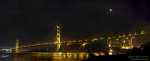 A Golden Gate Eclipse
9.04.2015
Shadows play on the water and in the sky in this panoramic view of the April 4 total lunar eclipse over San Francisco's Golden Gate Bridge. Just within planet Earth's shadow the Full Moon's disk is still easy to spot at its brief total phase.
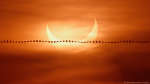 Eclipse Flyby
11.06.2021
On June 10 a New Moon passed in front of the Sun. In silhouette only two days after reaching apogee, the most distant point in its elliptical orbit, the Moon's small apparent size helped create an annular solar eclipse.
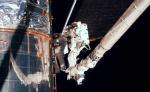 New Eyes for the Hubble Space Telescope
21.02.1997
The Hubble Space Telescope's second servicing mission has been completed. Every few years, the telescope is visited by a Space Shuttle to allow astronauts to switch old instruments for new. This time...
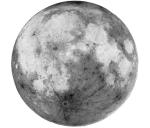 Full Moondark
12.12.2003
The brilliant full Moon might not have looked quite like this to skygazers this week, but the image is a mosaic of 18 digital frames recorded on December 9th at 3:30 UT.
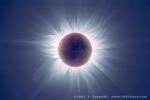 Moon AND Sun
7.09.2001
Today's composite image was made from 22 separate pictures of the Moon and Sun all taken from Chisamba, Zambia during the total phase of the 2001 June 21 solar eclipse. The multiple exposures...
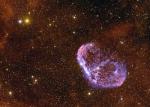 A Crescent Nebula Star Field
15.04.2003
What caused the Crescent Nebula? Looking like an emerging space cocoon, the Crescent Nebula, visible on the right, was created by the brightest star in its center. A leading progenitor hypothesis has the Crescent Nebula beginning to form about 250,000 years ago.
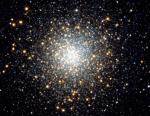 Hydrogen, Helium, and the Stars of M10
12.03.1999
Stars like the Sun use hydrogen for fuel, "burning" hydrogen into helium at their cores through nuclear fusion. But what happens when that hydrogen runs out? For a while, hydrogen burns in a shell surrounding the stellar core and the star expands to become a red giant.
 The Medusa Nebula
23.11.2007
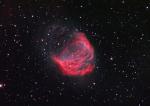
Braided, serpentine filaments of glowing gas suggest this nebula's popular name, The Medusa Nebula. Also known as Abell 21, this Medusa is an old planetary nebula some 1,500 light-years away in the constellation Gemini. Like its mythological namesake, the nebula is associated with a dramatic transformation.
 The Medusa Nebula
25.10.2012
Braided, serpentine filaments of glowing gas suggest this nebula's popular name, The Medusa Nebula. Also known as Abell 21, this Medusa is an old planetary nebula some 1,500 light-years away in the constellation Gemini. Like its mythological namesake, the nebula is associated with a dramatic transformation.
|
January February March April May June July August September |
|||||||||||||||||||||||||||||||||||||||||||||||||