
|
You entered: phases
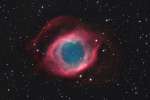 NGC 7293: The Helix Nebula
8.01.2011
A mere seven hundred light years from Earth, in the constellation Aquarius, a sun-like star is dying. Its last few thousand years have produced the Helix Nebula (NGC 7293), a well studied and nearby example of a Planetary Nebula, typical of this final phase of stellar evolution.
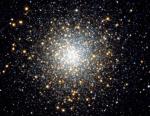 Hydrogen, Helium, and the Stars of M10
30.06.2001
Stars like the Sun use hydrogen for fuel, "burning" hydrogen into helium at their cores through nuclear fusion. But what happens when that hydrogen runs out? For a while, hydrogen burns in a shell surrounding the stellar core and the star expands to become a red giant.
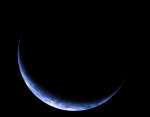 Crescent Earth from the Departing Rosetta Spacecraft
23.11.2009
Goodbye Earth. Earlier this month, ESA's interplanetary Rosetta spacecraft zoomed past the Earth on its way back across the Solar System. Pictured above, Earth showed a bright crescent phase featuring the South Pole to the passing rocket ship.
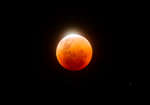 A Jewel on the Flower Moon
18.05.2022
Cloudy skies plagued some sky watchers on Sunday as May's Full Flower Moon slipped through Earth's shadow in a total lunar eclipse. In skies above Chile's Atacama desert this telephoto snapshot still captured an awesome spectacle though.
 Snowstorm on Planet Earth
31.01.2000
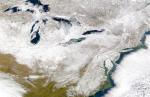
Earth is an ocean planet. From low Earth orbit, the Sea-viewing Wide Field-of-view Sensor (SeaWiFS) instrument onboard NASA's SeaStar spacecraft globally maps ocean color, tracking changes in the climate and biosphere of our water world.
 NGC 7293: The Helix Nebula
14.10.2021
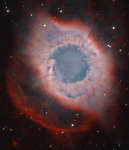
A mere seven hundred light years from Earth, toward the constellation Aquarius, a sun-like star is dying. Its last few thousand years have produced the Helix Nebula (NGC 7293), a well studied and nearby example of a Planetary Nebula, typical of this final phase of stellar evolution.
 Eclipse in the Mist
4.06.2003
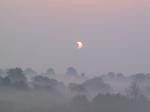
The Sun and Moon rose together over much of Europe on the morning of May 31st with the first solar eclipse of 2003 already in progress. And while sightings of the full annular phase...
 The Moving Moons of Saturn
27.06.2006
The moons of Saturn never stop. A space traveler orbiting the ringed giant planet would witness a continuing silent dance where Saturn's multiple moons pass near each other in numerous combinations. Like a miniature Solar System, the innermost moons orbit Saturn the fastest.
 APOD: 2015 July 8 In the Company of Dione
8.07.2015
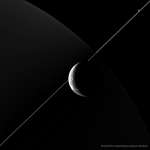
That is not our Moon. It's Dione, and its a moon of Saturn. The robotic Cassini spacecraft took the featured image during a flyby of Saturn's cratered Moon last month. Perhaps what makes this image so interesting, though, is the background.
 The Medusa Nebula
22.11.2024
Braided and serpentine filaments of glowing gas suggest this nebula's popular name, The Medusa Nebula. Also known as Abell 21, this Medusa is an old planetary nebula some 1,500 light-years away in the constellation Gemini. Like its mythological namesake, the nebula is associated with a dramatic transformation.
|
January February March April May June July August September |
|||||||||||||||||||||||||||||||||||||||||||||||||