
|
You entered: dust
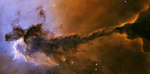 The Fairy of Eagle Nebula
9.12.2007
The dust sculptures of the Eagle Nebula are evaporating. As powerful starlight whittles away these cool cosmic mountains, the statuesque pillars that remain might be imagined as mythical beasts. Pictured above is one of several striking dust pillars of the Eagle Nebula that might be described as a gigantic alien fairy.
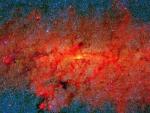 The Galactic Center Across the Infrared
7.07.2002
The center of our Galaxy is obscured in visible light by dark dust that rotates with the stars in the Galactic Plane. In this century, however, sensors have been developed that can detect light more red that humans can see - light called infrared.
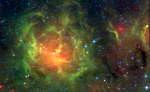 Infrared Trifid
31.12.2016
The Trifid Nebula, also known as Messier 20, is easy to find with a small telescope, a well known stop in the nebula rich constellation Sagittarius. But where visible light pictures show the nebula...
 APOD: 2024 November 27 Б The Meteor and the Comet
27.11.2024
How different are these two streaks? The streak on the upper right is Comet Tsuchinshan-Atlas showing an impressive dust tail. The comet is a large and dirty iceberg that entered the inner Solar System and is shedding gas and dust as it is warmed by the Sun's light.
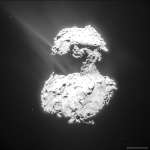 APOD: 2025 October 19 Б Comet Churyumov Gerasimenko Creates Its Tails
19.10.2025
Where do comet tails come from? There are usually no obvious places on the nuclei of comets from which the jets that create comet tails emanate. One of the best images of emerging jets...
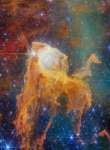 A Treasure Chest in the Carina Nebula
17.09.2026
This treasure chest is full of stars. The featured image was obtained with NASA's James Webb Space Telescope and shows a dust pilar in the Carina Nebula inside our Galaxy, roughly 7500 light-years away.
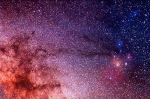 The Pipe Dark Nebula
28.05.1996
The dark nebula predominant at the lower left of the above photograph is known as the Pipe Nebula. The dark clouds, suggestively shaped like smoke rising from a pipe, are caused by absorption of background starlight by dust.
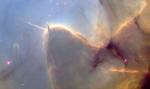 Trifid Pillars and Jets
28.12.2003
Dust pillars are like interstellar mountains. They survive because they are more dense than their surroundings, but they are being slowly eroded away by a hostile environment. Visible in the above picture...
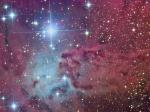 The Fox Fur Nebula
14.03.2005
The nebula surrounding bright star S Mon is filled with dark dust and glowing gas. The strange shapes originate from fine interstellar dust reacting in complex ways with the energetic light and hot gas being expelled by the young stars.
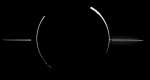 Jupiters Rings Revealed
17.06.2012
Why does Jupiter have rings? Jupiter's rings were discovered in 1979 by the passing Voyager 1 spacecraft, but their origin was a mystery. Data from the Galileo spacecraft that orbited Jupiter from 1995 to 2003 later confirmed that these rings were created by meteoroid impacts on small nearby moons.
|
January February March April May June July August September |
|||||||||||||||||||||||||||||||||||||||||||||||||