
|
You entered: star
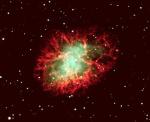 M1: Filaments of the Crab Nebula
8.02.1998
The Crab Nebula, filled with mysterious filaments, is the result of a star that exploded in 1054 AD. This spectacular supernova explosion was recorded by Chinese and (quite probably) Anasazi Indian astronomers. The filaments...
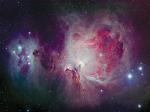 The Great Nebula in Orion
27.09.2004
The Great Nebula in Orion is a colorful place. Visible to the unaided eye, it appears as a small fuzzy patch in the constellation of Orion. Long exposure, digitally sharpened images like this, however, show the Orion Nebula to be a busy neighborhood of young stars, hot gas, and dark dust.
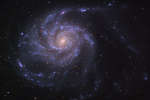 M101: The Pinwheel Galaxy
14.04.2009
Why do many galaxies appear as spirals? A striking example is M101, shown above, whose relatively close distance of about 27 million light years allow it to be studied in some detail. Recent evidence...
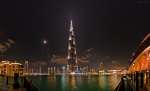 Starry Night over Dubai
16.07.2011
A starry night over the city of Dubai in the United Arab Emirates is really not so starry. In fact, the Moon is the only celestial beacon to come close to competing with city lights in this night skyscape, a situation all too familiar to urban skygazers.
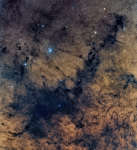 The Pipe Nebula
7.08.2020
East of Antares, dark markings sprawl through crowded star fields toward the center of our Milky Way Galaxy. Cataloged in the early 20th century by astronomer E. E. Barnard, the obscuring interstellar dust clouds include B59, B72, B77 and B78, seen in against the starry background.
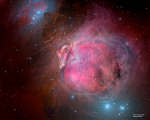 The Great Turkey Nebula
26.11.2020
Surprisingly reminiscent of The Great Nebula in Orion, The Great Turkey Nebula spans this creative field of view. Of course if it were the Orion Nebula it would be our closest large stellar nursery, found at the edge of a large molecular cloud a mere 1,500 light-years away.
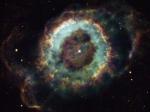 NGC 6369: The Little Ghost Nebula
7.02.2004
This pretty planetary nebula, cataloged as NGC 6369, was discovered by 18th century astronomer William Herschel as he used a telescope to explore the medicinal constellation Ophiucus. Round and planet-shaped, the nebula is also relatively faint and has acquired the popular moniker of Little Ghost Nebula.
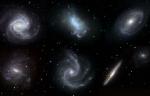 Visitors Galaxy Gallery
18.06.2005
A tantalizing assortment of island universes is assembled here. From top left to bottom right are the lovely but distant galaxies M61, NGC 4449, NGC 4725, NGC 5068, NGC 5247, and NGC 5775/5774. Most are spiral galaxies more or less like our own Milky Way.
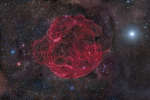 Simeis 147: Supernova Remnant
9.10.2012
It's easy to get lost following the intricate filaments in this detailed mosaic image of faint supernova remnant Simeis 147 (S147). Also cataloged as Sh2-240, it covers nearly 3 degrees or 6 full moons on the sky. That's about 150 light-years at the stellar debris cloud's estimated distance of 3,000 light-years.
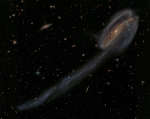 Arp 188 and the Tadpoles Tail
25.08.2014
Why does this galaxy have such a long tail? In this stunning vista, based on image data from the Hubble Legacy Archive, distant galaxies form a dramatic backdrop for disrupted spiral galaxy Arp 188, the Tadpole Galaxy. The cosmic tadpole is a mere 420 million light-years distant toward the northern constellation Draco.
|
January February March April May June July August September |
|||||||||||||||||||||||||||||||||||||||||||||||||