
|
You entered: star
 Geostationary Highway
20.02.2010
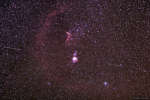
Put a satellite in a circular orbit about 42,000 kilometers from the center of the Earth (36,000 kilometers or so above the surface) and it will orbit once in 24 hours. Because that matches Earth's rotation period, it is known as a geosynchronous orbit.
 A Giant Planet for Beta Pic
3.07.2010
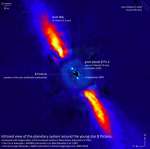
A mere 50 light-years away, young star Beta Pictoris became one of the most important stars in the sky in the early 1980s. Satellite and ground-based telescopic observations revealed the presence of a surrounding...
 APOD: 2025 June 27 Б Messier 109
27.06.2025
Big beautiful barred spiral galaxy Messier 109 is the 109th entry in Charles Messier's famous catalog of bright Nebulae and Star Clusters. You can find it just below the Big Dipper's bowl in the northern constellation Ursa Major.
 Antlia: A New Galactic Neighbor
23.04.1997
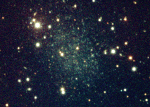
Meet Antlia, a newly discovered neighbor of our Milky Way Galaxy. Announced just last week, this faint member of our Local Group of Galaxies has only about one million stars. It is late in being noticed because it is so hard to see against a bright sky.
 A Quadruple Sky Over Great Salt Lake
13.09.2005
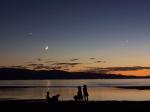
This was a sky to show the kids. All in all, three children, three planets, the Moon, a star, an airplane and a mom were all captured in one image near Great Salt Lake in Utah, USA on September 6.
 Venus, Zodiacal Light, and the Galactic Center
18.10.2013
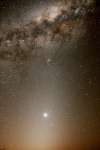
The bulging center of our Milky Way Galaxy rests on a pillar of light in this luminous skyscape. Recorded on September 22nd in dark South African skies, rivers of dust seem to flow downward from the galactic center towards Antares, yellowish alpha star of the constellation Scorpius, near the top of the scene.
 Alnitak, Alnilam, Mintaka
20.11.2025
Alnitak, Alnilam, and Mintaka are the bright bluish stars from east to west (upper right to lower left) along the diagonal in this cosmic vista. Otherwise known as the Belt of Orion, these three blue supergiant stars are hotter and much more massive than the Sun.
 APOD: 2026 August 16 Б Milky Way over Yellowstone
16.08.2026
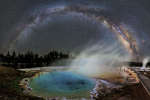
The Milky Way was not created by an evaporating lake. The colorful pool of water, about 10 meters across, is known as Silex Spring and is located in Yellowstone National Park in Wyoming, USA. Illuminated artificially, the colors are caused by layers of bacteria that grow in the hot spring.
 M27: Not a Comet
20.08.2015
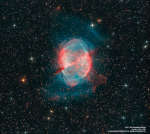
While hunting for comets in the skies above 18th century France, astronomer Charles Messier diligently kept a list of the things he encountered that were definitely not comets. This is number 27 on his now famous not-a-comet list.
 NGC 1333: Stellar Nursery in Perseus
22.04.2023
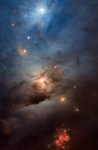
In visible light NGC 1333 is seen as a reflection nebula, dominated by bluish hues characteristic of starlight reflected by interstellar dust. A mere 1,000 light-years distant toward the heroic constellation Perseus, it lies at the edge of a large, star-forming molecular cloud.
|
January February March April May June July August September |
|||||||||||||||||||||||||||||||||||||||||||||||||